
Real Moto
| Developer | Dreamplay Games |
| Updated | Apr 2, 2026 |
| Size | 140 MB |
| Version | 1.3.175 |
| Requirements | 7.1 |
| Get it on |  |
Description
Real Moto puts 11 Super Motorbikes in your hands and sends you onto circuit tracks where Campaign Mode difficulty climbs with every new challenge stage. This post is for beginners and returning players who want to earn more upgrade pieces, choose better bikes, and stop losing races to the same avoidable mistakes. Here you will find coverage of the upgrade system, camera settings, campaign strategy, rider customisation, and the event mission reward loop that funds it all.
What Is Real Moto and How Does It Play?
Real Moto is a mobile motorcycle racing game developed and published by Dreamplay Games. It has reached over 10 million downloads globally across Android and iOS. The game centres on superbike circuit racing, where players compete against AI opponents and global rivals through a campaign structure and live leaderboard system.
The experience is built around speed and precision. Players choose from 11 unique superbikes, each with distinct base stats. Then they earn resources through event missions to upgrade each bike’s performance. The combination of racing skill and smart upgrades is what separates beginners from top-ranked players.
One thing that makes Real Moto stand apart from many mobile racers is its offline capability. Players can race through the entire campaign without a Wi-Fi connection. However, a live connection is needed to access Google Leaderboard rankings and collect ad rewards.
How the circuit racing and superbike control system works
The core mechanic in Real Moto is timed circuit racing. Players control a superbike around a closed course, competing to post the fastest possible lap or race time. The game offers multiple control options, so players can choose between tilt steering, tap controls, or a combination of both. These options make the game accessible to new players while still rewarding those who refine their input timing.
Each race involves managing the four upgrade stats — speed, acceleration, cornering, and braking. However, the track layout determines which stat matters most at any given moment. A tight technical circuit rewards high cornering ability. A long straight-heavy layout rewards top speed. Understanding this early gives players a major advantage in campaign progression.
The World Champion campaign premise and competitive tone
Real Moto frames its progression around a single goal: becoming the World Champion. The campaign mode places players on a path through increasingly difficult tracks. Early tracks are accessible and teach the basics of throttle control and braking. Later tracks demand precise cornering lines and well-upgraded bikes to complete.
The game’s tone is competitive and adrenaline-driven. Dreamplay Games designed the experience to feel like authentic superbike racing rather than an arcade spin-off. The realistic motor sounds, fluid superbike animations, and timed leaderboard challenges all reinforce that goal. Players who approach Real Moto casually will still enjoy it, but those who commit to optimising their bike setup will get far more out of it.
How Real Moto compares to other mobile motorcycle racing titles
Among Android and iOS motorcycle racers, Real Moto sits between Traffic Rider — which focuses on highway-style endless riding — and Asphalt 8, which uses a more arcade physics system with nitro boosts and dramatic stunts. Real Moto, by contrast, keeps the focus on pure circuit racing. There are no highway sequences or stunts. The four-stat upgrade system and campaign structure give it more depth than Traffic Rider’s single-lane format.
Compared to Asphalt 8, Real Moto feels more grounded. The handling responds to how well you upgrade cornering and braking, rather than relying on power-ups mid-race. Players who prefer a simulation-leaning motorcycle racer will find Real Moto fits that preference better than Asphalt’s action-heavy style.
How Controls and Viewpoints Work in Real Moto
Real Moto gives players more control flexibility than most mobile racers of its type. Before starting a race, players can choose their preferred control method. The game supports tilt steering, on-screen tap buttons, and a combined approach. This range of options means new players can pick the easiest method first, then switch as their confidence grows.
The control system connects directly to the upgrade stats on each superbike. A bike with high braking feels more responsive to brake inputs. A bike with upgraded cornering holds the racing line better through tight bends. So the controls do not exist in isolation — they interact with each bike’s tuned performance profile.
Mastering the controls early is important. Many beginners lose races not because of poor upgrades but because they brake too late or steer too aggressively. Smooth, consistent inputs matter more than raw speed in the early campaign tracks.
What the primary tilt and tap steering options do
Tilt steering uses the phone’s gyroscope to steer the bike by physically leaning the device. Many players find this feels the most immersive. However, tilt is sensitive, and small movements can throw the bike wide on tight corners. Players who prefer tilt should calibrate the sensitivity in the settings before racing.
Tap controls use on-screen left and right arrows to steer. This method is more precise for tight circuits because it removes the variability of physical motion. Many competitive players who aim for world record times use tap controls because the input is more repeatable and consistent across multiple laps.
How switching camera viewpoints affects cornering awareness
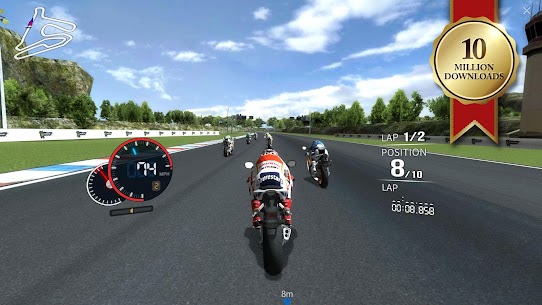
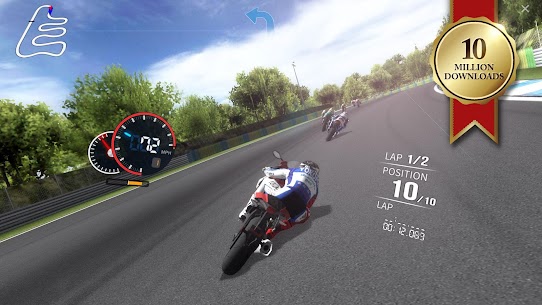
Real Moto offers multiple camera viewpoints, including a behind-the-bike view, a closer chase view, and in some versions a first-person perspective. The viewpoint choice significantly affects how well a player reads upcoming corners. A further-back view gives more peripheral awareness of the track ahead. A closer or first-person view increases immersion but narrows the field of vision.
For beginners, the wider chase camera is the better starting choice. It shows the corner entry point earlier, giving more time to brake and steer. As players become familiar with each circuit layout, they can experiment with closer viewpoints. Switching cameras mid-campaign can also feel like a meaningful difficulty step without changing any other settings.
What happens when you complete a race or challenge in Real Moto
Completing a race or clearing an event mission delivers rewards directly to the player’s inventory. These rewards include oil, coins, and upgrade pieces depending on which mission was completed. Oil is used to enter certain events, so managing it carefully matters. Coins fund direct upgrades, and upgrade pieces unlock specific stat improvements that coins alone cannot buy.
Beyond rewards, finishing races posts your time to the in-game performance record. If the time beats your previous best, it updates your standing. In connected mode, this also feeds into the Google Leaderboard. Every completed challenge therefore serves two purposes: earning resources and improving your competitive ranking.
How Campaign Mode and World Rank Mode Work in Real Moto
Real Moto separates its main content into two distinct modes. Campaign Mode is the offline-accessible single-player path that takes players through progressively harder tracks. World Rank Mode is the global competitive layer that requires a Google Play login and an internet connection. Both modes complement each other but serve very different purposes.
New players should start with Campaign Mode. It introduces the circuit layouts, teaches throttle and brake timing through repetition, and provides the resources needed to upgrade bikes. Skipping straight to World Rank Mode before completing campaign content results in competing with under-upgraded bikes against experienced riders. That leads to frustration rather than improvement.
Understanding which mode to focus on at each stage of progression is one of the most commonly missed pieces of information in Real Moto content. Most beginners bounce between both modes without realising that campaign rewards are the primary way to fund the upgrades needed to compete globally.
How difficulty scaling changes between early and late campaign tracks
Campaign Mode starts with tracks that favour straight-line speed and simple braking. The first few circuits reward aggressive acceleration and basic cornering. However, difficulty increases sharply after the first tier of tracks. Later campaign circuits introduce tighter chicanes, more technical corner sequences, and shorter braking zones. These layouts specifically punish players who have not upgraded their cornering and braking stats.
The difficulty scaling is intentional. Dreamplay Games designed it to push players toward the upgrade system as a natural progression gate. Therefore, players who grind early event missions to collect upgrade pieces before advancing will find the difficulty curve manageable. Those who rush forward without upgrading first will hit a wall on the harder tracks.
What World Rank Mode requires and how global competition works
World Rank Mode connects Real Moto to the Google Leaderboard. Players post their fastest race times and compete for position against riders worldwide. This mode requires both an active internet connection and a Google Play ID login. Without logging in, players cannot submit times or view their global ranking.
The global competition aspect is what makes Real Moto meaningful beyond campaign completion. Breaking into the top rankings requires a highly upgraded bike, refined cornering technique, and near-perfect lap consistency. However, even mid-tier rankings give players a goal to chase, which extends the game’s replay value well beyond the 150+ challenges.
How the Google Play login unlocks friend racing and leaderboard access
Logging in with a Google Play ID does more than unlock World Rank Mode. It also enables friend-specific leaderboards. Players can see where their connected contacts rank and race directly against their posted times. This social layer adds a meaningful competitive dimension that purely AI-based campaign racing does not provide.
Additionally, Google Play login enables Cloud Save, which protects upgrade progress and bike data if a device is lost or changed. However, players should save frequently using the in-game Save Data button. The Cloud Save function is not automatic, and data loss without a recent save cannot be recovered.
How the Google Leaderboard and World Record System Works
The Google Leaderboard in Real Moto is the game’s central competitive feature for connected players. It records the fastest race times posted globally and ranks them in real time. Every time a player completes a World Rank race with a new personal best, that time is uploaded and compared against the global pool.
Breaking world records in Real Moto is a specific in-game goal separate from the campaign. The game explicitly challenges players to beat existing records, and doing so is one of the most satisfying achievements the title offers. However, record-level times require a near-perfect combination of bike upgrade tuning and clean lap execution across every corner.
The leaderboard system also creates natural replay incentive. Even after completing all 150+ challenges, players return to chase faster times and higher rankings. This is where Real Moto’s upgrade depth pays off most clearly — small stat improvements translate into measurable time gains.
How Real Moto tracks your best times and posts them globally
Each race mode in Real Moto records the player’s best completion time for that specific circuit or challenge. When a new personal best is set while connected, it uploads automatically to the Google Leaderboard. The leaderboard displays the player’s rank among all registered participants for that event. Players can check their standing immediately after the time is posted.
Without an internet connection, times are recorded locally but not submitted. Therefore, players who race offline during campaign practice will not see those times reflected in their global ranking. Switching to a connected session before attempting a record-chasing run is important.
What breaking a world record requires in Real Moto
Breaking a world record in Real Moto requires several things working together at once. First, the bike must be upgraded to a competitive level — particularly the speed and cornering stats on circuits that reward both. Second, the control method must be consistent enough to hit the same braking and steering inputs on every lap. Third, the player must know the specific circuit layout well enough to take the fastest possible racing line.
Most record attempts fail at the corner exit phase. Players who apply throttle too early on corner exits lose traction time, which costs tenths of a second per corner. That adds up to full seconds over a complete lap. Practising corner exit timing specifically — rather than general race speed — is the most direct path to competitive times.
How offline play affects your leaderboard ranking in Real Moto
Real Moto’s offline capability is one of its most practical features for daily play. The game explicitly states that no Wi-Fi is required for the core gameplay. Campaign mode, bike upgrades, and event missions are fully accessible offline. However, the Google Leaderboard requires an active connection to submit or refresh rankings.
Players who use offline mode for practice should know that their offline times remain private until they reconnect. Additionally, ad-based rewards — extra oil, coins, and other bonuses from watching video ads — are not available without a connection. For free-to-play players who rely on ad rewards to supplement their upgrade resources, staying connected during active play sessions is more efficient.
How Progression and Bike Upgrades Work in Real Moto
The progression system in Real Moto is built around three currencies: oil, coins, and upgrade pieces. Each serves a distinct function in the upgrade chain. Oil manages access to events — players spend oil to enter certain missions. Coins fund direct stat upgrades on each bike. Upgrade pieces are the rarer resource that unlocks specific upgrade tiers that cannot be purchased with coins alone.
Players earn all three resources by completing event missions and campaign races. The game’s tip system confirms this: clearing an event mission delivers a reward combination, and the type of reward depends on the mission type. Therefore, selecting which missions to replay for specific resources is a skill in itself.
Most beginners make the mistake of spending coins the moment they earn them. However, saving coins until upgrade pieces are available for a specific stat improvement is more efficient. Spending coins on a stat before the matching upgrade piece is collected resets part of the upgrade cost cycle.
What oil, coins, and upgrade pieces do in the progression system
Oil is the event-access resource. Players spend a set amount of oil to enter timed event missions. These missions deliver the best rewards per session but are gated by oil supply. Oil regenerates over time and can also be collected from completed challenges. Managing oil means not burning it on events that deliver low-value rewards relative to the oil cost.
Coins are the general upgrade currency. They fund incremental stat improvements across speed, acceleration, cornering, and braking on each superbike. Coins are more abundant than upgrade pieces and regenerate through normal race completions. However, higher-tier upgrades cost significantly more coins, so conservation in the early game matters.
Upgrade pieces are the rarest resource. They are tied to specific upgrade tiers and must be collected before those upgrades become available. The game’s tip system explicitly states that players should “practice often and collect upgrade pieces” — this is not casual advice but a core instruction about how the upgrade ceiling works.
How to use upgrade pieces before spending coins in Real Moto
The most efficient upgrade sequence in Real Moto is to collect upgrade pieces for a specific stat tier first, then spend coins to activate that tier. Spending coins on a partially complete upgrade tier before collecting the required pieces means paying full coin cost without unlocking the stat increase. That is a wasted spend.
Players should identify which stat is limiting their performance on the current campaign track. If cornering is the issue, they should focus on collecting cornering upgrade pieces through event missions before touching coins for that stat. This targeted approach avoids over-investing in speed upgrades while the bike’s cornering drags down lap times on technical circuits.
What completing event missions unlocks at each stage
Event missions in Real Moto are structured challenges that reward specific resource types. Early missions primarily deliver coins and small amounts of oil. Mid-game missions begin delivering upgrade pieces alongside coins, which is when they become the most valuable play loop. Late-game missions offer higher-grade upgrade pieces that unlock the top stat tiers on the most powerful superbikes.
Completing all available event missions before advancing in campaign mode is the most resource-efficient approach. Because mission rewards scale with campaign progression, clearing missions in sequence — rather than skipping ahead — ensures players always have the resources needed for the current difficulty tier. Rushing the campaign without completing missions forces players to grind older events for catch-up resources.
How Racer and Bike Customisation Works in Real Moto
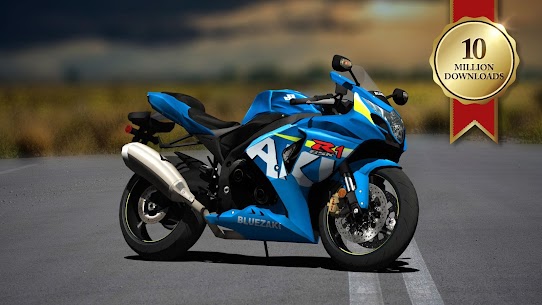
Customisation in Real Moto covers both the superbike and the racer. Players can apply colour schemes to each of the 11 unique bikes and change the suit and helmet worn by the rider. Neither customisation type affects performance stats — both are purely visual. However, they play a meaningful role in how players present themselves on the Google Leaderboard and in multiplayer sessions.
The customisation system is accessible early in the game. Players do not need to reach a specific campaign milestone to start changing bike colours or rider appearance. This means even new players can establish a personalised visual identity before they become competitive on the leaderboard.
For a mobile racing game with over 10 million downloads, Real Moto’s customisation options are modest but functional. The 11 bike roster covers distinct visual styles, and the suit and helmet options create enough variety to feel individual without overwhelming the player with unnecessary complexity.
What bike colour options are available across the 11 superbikes
Each of the 11 superbikes in Real Moto supports colour customisation. Players can apply different colour schemes to match personal preference or to visually distinguish their primary race bike from others. The colour options are not described as licensed liveries — they are general palette choices that change the bike’s appearance without altering its stats.
Choosing a distinctive colour scheme for the bike you use most frequently helps with quick visual identification in replay mode and on leaderboard displays. It is a small quality-of-life detail, but it adds to the sense of ownership over a specific superbike in the roster.
How suit and helmet customisation changes your racer’s appearance
The racer customisation system in Real Moto lets players change the suit and helmet independently. This means colour combinations and protective gear styles can be mixed and matched. A player racing on the leaderboard appears with their current racer appearance, so the customisation carries through to the competitive layer.
Suit and helmet options span a range of colour styles. Some players match their racer outfit to their bike colour for a consistent visual identity. Others prefer contrast between racer and bike for visual clarity during replay footage. Either approach works — the system is designed to give players freedom without requiring premium currency to unlock basic options.
Why visual customisation matters for player identity on the leaderboard
On the Google Leaderboard, players appear alongside their times and racer profile. A well-customised racer stands out visually among generic default appearances. This matters more than it seems — leaderboard pages show profile visuals alongside rankings, and a distinctive appearance reinforces the competitive identity players build through their times.
Additionally, players who race against friends via Google Play can recognise each other by their racer appearance in the results. Therefore, investing a few minutes in customisation early pays off socially over time. It is a small but effective engagement feature that Dreamplay Games embedded in the competitive layer intentionally.
Best Real Moto Tips and Tricks for Beginners
Starting strong in Real Moto comes down to three specific habits: upgrading the right stat first, farming event missions efficiently, and practising circuits before committing upgrade resources to a specific bike. Players who build these habits in the first few hours avoid the most common frustration points in the game.
Most beginners focus exclusively on top speed. However, speed upgrades produce the smallest improvement on technical circuits where cornering and braking are the limiting factors. Shifting upgrade priority based on track type — not personal preference — is the mindset shift that separates fast learners from players who plateau early.
Practising circuits without racing pressure is also underused. Because Real Moto allows offline play, players can run circuits repeatedly at no resource cost. This builds track familiarity before committing to a ranked or event-gated run where mistakes cost oil or a missed podium.
How to prioritise the cornering upgrade stat before speed in early campaign tracks
The early campaign tracks in Real Moto feature tight corners that punish under-upgraded cornering stats more than any other deficit. A superbike with high speed but low cornering will consistently run wide on corner exits, forcing braking corrections that cost several tenths per lap. Upgrading cornering first eliminates this consistent loss point.
Speed upgrades become more valuable as tracks open up into longer straight sections in the mid-campaign tier. Therefore, the correct upgrade sequence for most beginners is: cornering first, braking second, acceleration third, and speed last. This sequence directly counters the most common early-game loss pattern in Real Moto’s campaign structure.
How to earn upgrade pieces faster by replaying specific event missions in Real Moto
Upgrade pieces drop most reliably from event missions rather than standard campaign races. Specifically, missions that award oil as their primary reward often include upgrade pieces as a secondary reward. Players who replay these missions — rather than general campaign races — accumulate upgrade pieces faster.
The key is identifying which event missions are currently available and checking their reward preview before spending oil to enter. Missions that list upgrade pieces as a guaranteed or common reward should be prioritised. Because oil regenerates over time, returning to the game in short sessions throughout the day and clearing available missions is more efficient than playing one long session of campaign races.
Why practising each circuit in offline mode prevents costly upgrade mistakes
One of the most overlooked features in Real Moto is the ability to run circuits offline without consuming oil or committing to a leaderboard attempt. Practising a circuit in offline mode allows players to learn the corner entry points, braking zones, and racing line without the resource cost of an event mission.
This matters because a common beginner mistake is upgrading the wrong stat for a specific track after failing it multiple times. If a player believes their bike is “too slow” on a circuit but the real issue is cornering, they will waste coins on speed upgrades that produce no improvement. Practising the circuit first reveals whether the failure point is a stat gap or a technique gap — and that distinction saves significant resources over the course of the campaign.
Frequently Asked Questions About Real Moto
Is Real Moto available on iOS and Android?
Yes, Real Moto is available on both Android and iOS. Android players can find it on the Google Play Store, and iOS players can download it from the Apple App Store. The game is free to play on both platforms. It has surpassed 10 million downloads globally since its release by Dreamplay Games, making it one of the more widely played mobile motorcycle racers available.
How many bikes are in Real Moto?
Real Moto features 11 unique superbikes. Each bike has distinct base stats across speed, acceleration, cornering, and braking. Players can upgrade each of the four stats using coins and upgrade pieces earned through event missions and campaign races. Every bike also supports colour customisation, so players can personalise their fleet independently from performance upgrades.
Does Real Moto require an internet connection to play?
Real Moto does not require an internet connection to play the core campaign and event missions. The game specifically advertises an offline mode. However, an active connection is needed to access Google Leaderboard rankings, submit world record times, collect ad-based rewards, and use the Google Play friend racing features. Cloud Save also requires a live connection and a Google Play ID login.
Why Real Moto Rewards Players Who Focus on Track Consistency
Real Moto is a well-built mobile motorcycle racer that rewards patience and systematic upgrade progression. The 11-superbike roster, four-stat upgrade system, and 150+ challenges give it more structured depth than most free mobile racers. After spending time with the campaign and leaderboard system, the experience that stands out most is how consistently the game rewards players who learn each circuit rather than those who simply spend the most on upgrades. The Google Leaderboard adds genuine competitive meaning to personal bests. For any mobile racing fan who wants a focused, offline-capable motorcycle sim with real replay value, Real Moto delivers exactly that and earns its 10 million download milestone.
Images


What's new
Improve system environments stability.
Minor bug fix.



Latest Games
Popular Games


