
Traffic Rider
| Developer | skgames |
| Updated | Dec 8, 2025 |
| Size | 170 MB |
| Version | 2.11 |
| Requirements | 7.0 |
| Get it on |  |
Description
Traffic Rider puts you directly behind the handlebars in full first-person view, using real recorded engine sounds that change with speed to make every overtake feel authentic. This post is written for beginners who want to earn cash faster, progress through career mode sooner, and avoid the common mistakes that stall early progress. Below, this post covers the four game modes, how the near-miss scoring system works, how to pick and upgrade bikes, and the entire career mode mission structure.
What Is Traffic Rider and How Does It Play
Traffic Rider is a first-person motorcycle racing game developed by Soner Kara under the skgames label. Players ride through endless highway roads, dodging traffic, completing missions, and spending earned cash on new bikes and upgrades. The game is available free on both Android and iOS, with optional in-app purchases for players who want to progress faster.
The core design sits between arcade racing and light simulation. However, it carries more depth than a typical endless runner because of its structured career mode and bike economy. The first-person view replaces the usual third-person camera common in mobile racing games, which changes how players judge distance and timing during tight overtakes.
How the first-person motorbike riding mechanic works
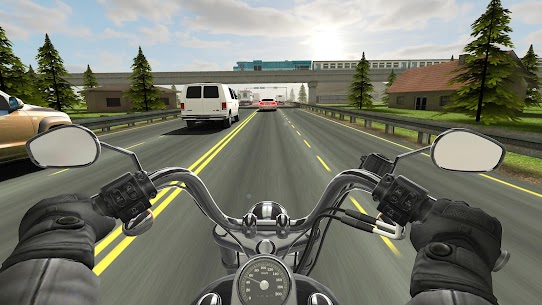
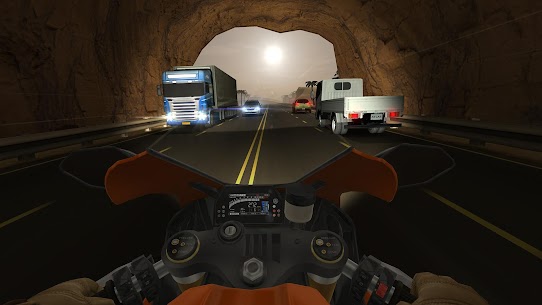
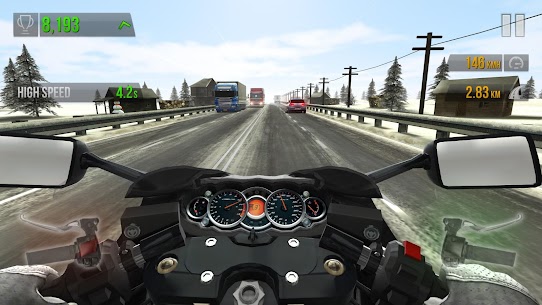
The first-person camera places the player in the rider’s seat with a cockpit-style perspective. Players see the handlebars, the road ahead, and traffic approaching at high speed. This view makes distance judgment more challenging than a third-person camera — but also more rewarding when a near-miss lands correctly.
The game responds to tilt controls or on-screen buttons depending on the player’s preference. Throttle, braking, and steering all function with a light arcade feel. However, the handling becomes more demanding at higher speeds, where a slight steering error at 150 km/h can result in a crash and a failed mission.
The highway setting, day and night environments, and tone
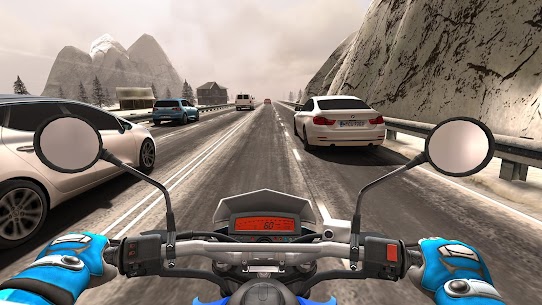
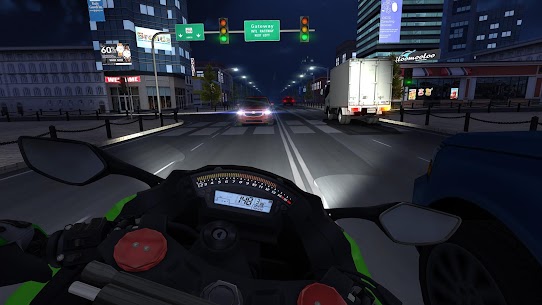
Traffic Rider is set on fictional multi-lane highway roads designed to feel like real-world motorways. The environments shift between day, evening, and night conditions, and the game includes weather-like lighting changes that alter visibility during runs. Because of this, night missions require more caution than daytime runs at similar speeds.
The overall tone is straightforward and action-focused. There is no story, no narrative, and no dialogue. Instead, the game relies on the physical sensation of speed, the sound of real recorded engine audio, and the tension of close traffic to create its atmosphere. Players who enjoy pure gameplay mechanics will find this tone satisfying.
How Traffic Rider compares to Moto Rider GO and Traffic Racer on mobile
On the Android market, the two closest mobile competitors to Traffic Rider are Traffic Racer (by the same developer) and Moto Rider GO: Highway Traffic by TrimcoGames. Traffic Racer uses a third-person car perspective and lacks a structured career mode, which means players who want mission-based progression will find Traffic Rider more rewarding. Moto Rider GO offers similar bike-based highway gameplay but with a simpler scoring system and fewer bike options.
The key difference between Traffic Rider and both competitors is the first-person camera combined with real recorded engine sounds. No other mobile title in this genre replicates that specific combination. Additionally, Traffic Rider’s 34-bike garage is significantly larger than Moto Rider GO’s roster, giving players more long-term progression goals.
How Traffic Rider Gameplay Controls and Scoring Work
The scoring system in Traffic Rider is more layered than it first appears. Speed alone does not maximise cash earnings. Therefore, players who treat it as a simple go-fast game leave a large portion of rewards uncollected. Understanding how the scoring layers interact is the fastest way to accelerate progression.
How throttle, braking, and steering controls function in first-person view
Players control the bike using either tilt-based steering (by physically tilting the device) or on-screen buttons. The throttle appears on the right side of the screen, and the brake appears on the left. Steering sensitivity adjusts in the game settings, which is worth changing early because the default sensitivity is high for beginners.
Braking in Traffic Rider triggers a slow-down animation and reduces the near-miss multiplier if used too frequently during a run. Consequently, experienced players use braking sparingly and instead steer around traffic at speed. This creates a risk-reward dynamic where avoiding the brake earns more cash, but requires tighter control.
How near-miss overtaking above 100 km/h triggers bonus cash and multipliers
The near-miss system is the most important mechanic in Traffic Rider for cash generation. When players overtake a traffic car at above 100 km/h and pass within a very close distance without colliding, the game triggers a near-miss bonus. This bonus adds cash and multiplies the score for subsequent overtakes in the same run.
Stacking near-misses in quick succession increases the multiplier further. So, a run with ten consecutive close overtakes earns significantly more than a run where the player maintains safe distances at the same speed. Players who learn to position themselves deliberately within centimetres of passing cars during highway sections will see their cash earnings double or triple per session.
What happens after completing or failing a career mode mission
After completing a mission, Traffic Rider displays a results screen showing total score, cash earned, and any achievement progress triggered during the run. Cash transfers directly to the player’s garage account and is available immediately for bike upgrades or purchases.
Failing a mission — by crashing or not meeting the mission objective — returns the player to the career map with no cash earned for that attempt. However, the game allows immediate retry without any waiting period or fuel system. This means players can attempt difficult missions repeatedly in a short session without penalty.
What Are the Four Game Modes in Traffic Rider
Traffic Rider offers four distinct game modes, each serving a different player goal. Understanding which mode to use for which purpose speeds up both cash accumulation and mission progress. Many beginners default to Endless Mode because it feels familiar, but Career Mode consistently delivers more cash per hour of play for focused players.
How Career Mode structures its 90+ missions and cash rewards
Career Mode is the primary progression system in Traffic Rider. It presents over 90 missions organised by difficulty level, with each mission assigning a specific objective — such as reaching a target speed, surviving a set distance, or earning a cash total in a single run. Completing missions unlocks the next tier of missions and often pays a cash bonus on top of the in-run earnings.
The missions increase in difficulty steadily. Early missions function as a gentle warm-up, requiring players to sustain basic speeds. However, later career missions demand specific bikes with minimum stats, which means players must invest in upgrades before certain mission tiers become completable. This creates a clear upgrade-before-progress loop that defines the rhythm of progression.
How Endless Mode and Time Trial differ in scoring and purpose
Endless Mode removes the mission objective and simply asks players to ride as far as possible without crashing. The game ends when the player crashes, and the score records to the online leaderboard. This mode is useful for practising near-miss timing and learning how to read traffic density at high speeds.
Time Trial Mode asks players to cover a set distance within a countdown timer. However, the cash earned in Time Trial is lower per run than Career Mode for the same time investment. Therefore, players who need cash for bike purchases should prioritise Career Mode, while Endless and Time Trial serve better as skill-building tools.
What Free Ride mode offers and when to use it for cash grinding
Free Ride removes all traffic from the road and gives players an open highway with no objectives. This mode is useful for new players learning the controls without the stress of collisions. However, because traffic is absent, the near-miss scoring system does not activate, which means cash earnings are minimal.
The best use of Free Ride is during early sessions when a player is still calibrating tilt sensitivity or button positioning. After the first few hours, players earn more by switching to Career Mode missions, which stack traffic density bonuses, near-miss multipliers, and mission completion cash in a single run.
How to Buy and Upgrade Bikes in Traffic Rider
The bike garage is one of the most important systems in Traffic Rider. Choosing the right bike at the right stage of progression directly affects mission success rates. Spending cash on upgrades before purchasing a new bike is almost always more efficient in the early game.
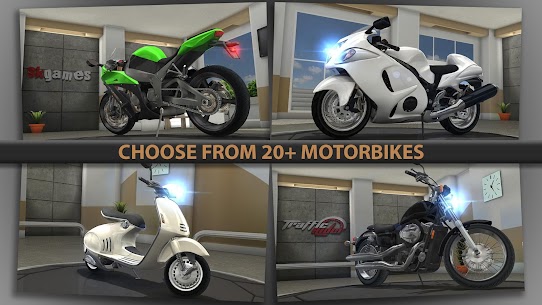
How the 34-bike garage is structured and what bike tiers exist
Traffic Rider offers 34 motorbikes grouped into tiers roughly organised by price and performance. The starting bike is a basic model with limited top speed and poor handling at high velocity. As players earn cash, they unlock progressively faster and more stable bikes that can sustain the speeds needed for advanced career missions.
The garage shows each bike’s top speed, acceleration, brake rating, and handling score. However, those displayed stats do not tell the full story. Some mid-tier bikes have handling ratings that suit beginners better than faster bikes with lower control scores. Choosing by handling as well as speed produces better career mission results than chasing raw top speed.
How bike upgrades affect speed, handling, and mission performance
Each bike in Traffic Rider accepts individual upgrades to engine, transmission, brakes, and tyre grip. Each upgrade tier costs cash and provides a measurable stat boost. Fully upgrading a mid-tier bike can make it perform close to a higher-tier stock bike at a fraction of the purchase price.
Because of this, players in the mid-game should upgrade their current bike to at least two upgrade tiers before spending on a new purchase. A fully upgraded bike also earns cash slightly faster per run than a stock bike of the same tier because it sustains higher speeds with better control. This compounds over multiple sessions.
How the passive income mechanic on each bike works every four hours
Every bike in the garage generates a small amount of passive cash that players can collect every four hours. This idle income accumulates while the player is offline and resets upon collection. Most players overlook this entirely — but it provides a consistent daily bonus that adds up significantly over a week of regular play.
The passive income per bike scales with the bike’s purchase price. Therefore, buying multiple bikes and collecting their passive income every four hours is a legitimate strategy for funding expensive upgrades without extending session time. Players who log in twice daily consistently earn more than players who play longer but only once per day.
How Achievements and Leaderboards Add Replayability
Traffic Rider includes over 30 achievements and a global online leaderboard. These systems exist beyond the career missions and give players long-term targets once the primary mission arc is complete. However, many players complete the career mode and then quit without realising how much content remains in the achievement system.
What the 30+ achievements require and which ones pay out the most cash
The achievements in Traffic Rider cover a wide range of actions — reaching set speeds, completing distance milestones, executing a certain number of near-misses, performing wheelies, and finishing career missions within time limits. Each completed achievement pays a cash bonus on collection. Some achievements chain in sequence, so completing one unlocks the next in a series.
The highest-paying achievements tend to involve distance milestones in Endless Mode and near-miss count targets. Because these require sustained skilled play over multiple sessions, they reward players who have already mastered the core mechanics. Beginners should focus on career missions first and treat achievements as a secondary stream of income.
How online leaderboards track near-miss scores and career progress
The global leaderboard ranks players by their best scores in Endless Mode. The score combines distance, speed, near-miss count, and wheelie bonuses. Players who practice the near-miss multiplier system consistently will rise through the leaderboard faster than players who rely purely on distance.
The leaderboard is optional and does not affect single-player progression. However, it motivates replay sessions beyond the career missions. Competitive players who enjoy comparing scores with others around the world will find this extends the game’s lifespan considerably.
What completing the full achievement list unlocks for dedicated players
Completing the full achievement list does not unlock a secret mode or hidden content. However, the cash accumulated through all 30+ achievements is sufficient to purchase several of the garage’s higher-tier bikes without grinding additional sessions. Additionally, completing all achievements signals a level of mastery over every mechanic in the game.
The achievement system also serves as a structured checklist for players who have finished the 90-mission career arc. Because career completion does not end the game, achievements become the natural next goal. Players who complete both the career mode and the achievement list have experienced essentially everything Traffic Rider offers at its current version.
What Most Traffic Rider Players Get Wrong About Scoring
The single biggest mistake most players make in Traffic Rider is treating speed as the only variable that matters. However, speed alone without near-miss positioning produces far lower cash rewards than a controlled, deliberate run that targets close overtakes at speed. Understanding the full scoring stack changes how every session should be approached.
Why riding at opposite-direction two-way roads earns more cash than speed alone
Two-way road sections appear in specific career missions and in certain Endless Mode settings. When players ride in the opposing traffic direction on these roads, the game assigns a significant cash and score multiplier for each vehicle passed. The multiplier activates because the relative speed between the player’s bike and oncoming traffic is much higher, making each pass more dangerous.
However, two-way riding requires a completely different approach to steering. Players must think further ahead because oncoming vehicles leave far less reaction time. Combining two-way riding with close-pass distance creates the highest single-run scoring potential in the entire game. The cash difference per session compared to same-direction riding at the same speed is substantial.
How wheelies and near-misses stack multipliers in a single run
Wheelies generate a score bonus in Traffic Rider by holding the throttle at maximum while pulling back slightly on the steering. However, the real value of wheelies comes from performing them simultaneously with high-speed near-misses. The game stacks both bonuses, so a wheelie executed while passing closely beside a traffic car at over 100 km/h produces a combined multiplier that neither action generates alone.
The window for wheelie execution is narrow at lower speeds. Therefore, this technique only becomes reliably valuable once the player rides bikes capable of sustained speeds above 120 km/h. Beginners should prioritise near-miss timing first and add wheelie execution as a secondary technique once speed control feels consistent.
Why bike choice matters more than speed settings on harder career missions
Later career missions specify minimum objectives that low-tier bikes cannot meet regardless of how well the player rides. Some missions require the player to sustain speeds that entry-level bikes cannot reach even when fully upgraded. Because of this, players who delay buying a higher-tier bike will hit a wall in career mode that no amount of skilled riding can overcome.
The practical advice is to check the next mission’s objective before spending cash on upgrades. If the mission speed requirement is close to the current bike’s maximum, one upgrade tier will solve the problem. However, if the gap is large, buying the next bike tier is the more efficient use of cash. Recognising this distinction early prevents wasted spending.
Best Traffic Rider Tips and Tricks for Beginners
How to use the 100 km/h close-overtake threshold to maximise cash per run
The 100 km/h threshold is the specific speed above which Traffic Rider activates the close-overtake bonus. Below this speed, passing beside a traffic car earns no extra reward. Above it, the closer the pass, the higher the bonus. Beginners should aim to stay at or above 100 km/h during all active overtaking sections and position the bike within the smallest safe margin beside each car.
Practising this in Endless Mode before applying it in Career Mode builds the muscle memory needed to hit the threshold consistently. Additionally, choosing a road section with dense traffic clusters rather than open highway gives more opportunities to chain near-misses per second of riding.
When to switch out of Endless Mode into Career Mode for faster bike unlocks
Endless Mode is the natural starting point because it has no failure condition. However, it produces significantly less cash per session than Career Mode for a player with even basic control skills. Therefore, beginners should move into Career Mode after their first two or three Endless sessions, once they can sustain speed above 100 km/h without frequent crashes.
Career Mode’s structured mission rewards stack the completion bonus on top of in-run earnings. This double-layer income stream unlocks bike tiers notably faster than Endless Mode grinding. Also, career missions teach specific skills — like sustaining speed through dense traffic — that directly improve Endless Mode scores later.
How to avoid the empty-garage mistake that kills cash flow in early career missions
The empty-garage mistake happens when beginners spend all available cash on one new bike immediately after earning it, leaving zero funds for upgrades. A newly purchased bike with no upgrades will often underperform a fully upgraded previous bike. Consequently, career missions become much harder than they need to be.
The solution is to maintain a minimum cash reserve — enough for at least two upgrade tiers — before buying a new bike. Additionally, players should collect passive income from each owned bike every four hours to maintain a steady cash buffer. Following this approach keeps upgrade options open and prevents the stalled progression that many beginners experience around the mid-career mission tier.
Frequently Asked Questions About Traffic Rider
Is Traffic Rider available on iOS and Android?
Traffic Rider is available on both iOS and Android as a free download. Players can find it on the Google Play Store under developer skgames and on the Apple App Store. Both versions include the same career mode, bike roster, and game modes, with optional in-app purchases available on both platforms.
How many missions are in Traffic Rider career mode?
Traffic Rider’s career mode contains over 90 missions in total. The missions increase in difficulty progressively, with later missions requiring faster bikes and more precise near-miss skills to complete within the scoring thresholds. Players who complete all 90+ missions will have unlocked several bike tiers and accumulated a substantial achievement count along the way.
Does Traffic Rider have online multiplayer or leaderboards?
Traffic Rider does not offer real-time online multiplayer. However, it includes global online leaderboards where players can compare their Endless Mode scores with others worldwide. The game also supports 30+ achievements and cross-player score comparisons. This makes the competitive element asynchronous rather than live, which suits the mobile casual format well.
Why Traffic Rider Remains One of the Best Mobile Bike Racing Games
Traffic Rider suits mobile players who want more than a simple endless runner but do not want the complexity of a full racing simulation. The career mode’s 90+ missions give casual players a clear progression path, while the near-miss scoring system rewards skilled play with noticeably higher cash returns. First-time players will find the first-person camera challenging at first but deeply satisfying once near-miss timing clicks. Having spent time working through the career mode missions and building out the full 34-bike garage, the combination of real engine sounds and responsive first-person controls creates an arcade experience that most mobile racing games still have not matched. Traffic Rider remains a strong choice for anyone who wants a focused, high-quality mobile motorcycle game with genuine long-term depth.
Images
Related apps


Developer's apps
Latest Games
Popular Games


