
MEGA MAN X DiVE Offline
| Developer | CAPCOM CO. LTD. |
| Updated | Oct 21, 2025 |
| Size | 2 GB |
| Version | 1.0.1 |
| Requirements | 6.0 |
| Get it on |  |
Description
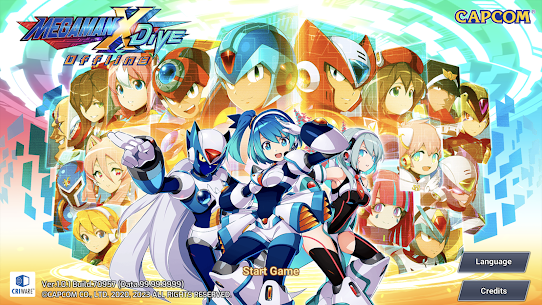
MEGA MAN X DiVE Offline drops players into Deep Log, a fractured digital archive of the entire Mega Man X series, where every stage cleared repairs corrupted game data one fight at a time. This post is written for beginners picking up the offline version for the first time and for returning players transitioning from the online live-service game. You will find sections covering core gameplay mechanics, the weapon and card upgrade system, Hunter Program progression, and the most common mistakes new players make early on.
What Is MEGA MAN X DiVE Offline
MEGA MAN X DiVE Offline is a premium side-scrolling action game from Capcom. It takes the foundation of the Mega Man X series and rebuilds it inside a self-contained offline experience. Because the game requires no internet connection after installation, every piece of content is available from the moment you open the app. No rotating banners, no time-limited events, and no server shutdowns to worry about.
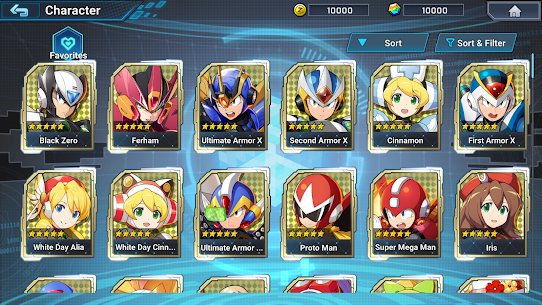
The offline version includes hundreds of stages spread across multiple difficulty levels inside Deep Log. Players battle through waves of Irregular Data and boss-tier enemies using Hunter Programs. These are playable recreations of Mega Man X series characters. The game ships with over 100 Hunter Programs, so the breadth of content rivals what the online version accumulated over years of live updates.
How the Deep Log Side-Scrolling Action System Works
Deep Log functions as the game’s central hub and narrative backdrop. Inside it, all Mega Man X game data has been archived digitally. However, a bug of unknown origins has fragmented that data. Each stage represents corrupted game data that players must clear to restore.
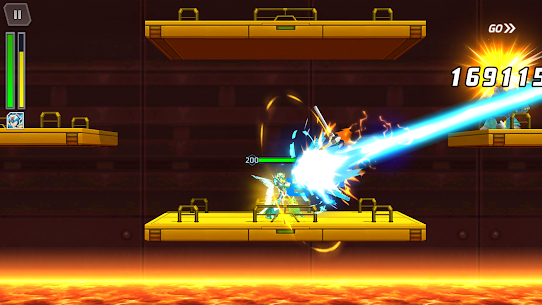
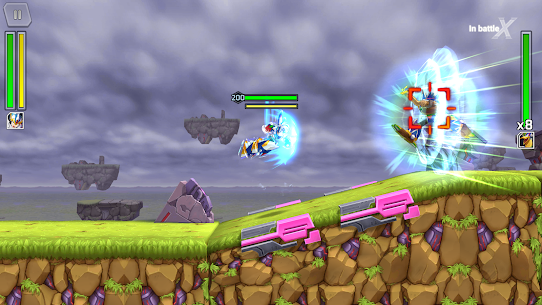
The action itself follows the Mega Man X blueprint closely. Players jump, dash, fire their buster, and swing their saber across stages filled with Irregular Data enemies. The offline version adds a 360-degree aiming system that the classic X games never had. That single addition changes how combat feels, especially during multi-directional enemy waves.
The Story Behind Deep Log and RiCO’s Role
RiCO serves as the player’s navigator throughout the campaign. She appears at the start of each major section of Deep Log. Her dialogue connects the abstract concept of digital game data restoration to concrete mission objectives. Capcom created her specifically for this game, not as a carryover from the mainline Mega Man X series.
The story premise is straightforward but effective. Players are not controlling X or Zero directly in a narrative sense. Instead, they control Hunter Programs, which are digital recreations of those legendary characters. This distinction matters because it explains why the roster contains over 100 variants and alternate designs. Each Hunter Program is a different data recreation, not a different storyline character.
How MEGA MAN X DiVE Offline Compares to Dead Cells Mobile and Stickman Legends
Dead Cells Mobile on Android offers procedurally generated levels and a roguelite structure where death resets your run. MEGA MAN X DiVE Offline, by contrast, uses fixed stage design with persistent character progression. Players keep every level gained, every weapon upgraded, and every card collected regardless of how a stage ends. For players who dislike losing progress on death, the offline version is the more accessible choice.
Stickman Legends: Shadow Fight on Android also features action combat with character leveling and weapon upgrades. However, its roster is narrow compared to the 100-plus Hunter Programs available here. Additionally, the Deep Log stage variety spans multiple Mega Man X game eras. Both games are worth playing, but they serve different player appetites.
MEGA MAN X DiVE Offline Gameplay Mechanics and Controls
The controls in MEGA MAN X DiVE Offline are fully customizable. Players can scale and reposition every touchscreen button to match their grip and playstyle before entering a single stage. Setting up controls before the first real stage is one of the most important steps a new player can take.
The game targets a wide range of Android and iOS device sizes, so the default control layout will not suit everyone. Larger phones benefit from buttons positioned further toward the edges. Smaller screens work better with a compressed layout. Capcom included this customization because the online version launched with fixed controls and player feedback was vocal.
Buster Fire, Saber Attacks, and the 360-Degree Aiming System
Buster fire is the primary ranged attack. Most Hunter Programs start with a basic buster that fires horizontally. However, the 360-degree aiming system allows players to hold a directional input while firing to shift the angle of the shot. That is essential for hitting aerial Irregular Data without jumping first.
Saber attacks are the close-range option. They deal higher damage per hit but require positioning. Because dashing closes distance quickly, the most effective combat rhythm combines a dash into saber range, delivers two to three saber hits, then dashes back out before the Irregular Data counterattacks. That pattern is the core offensive loop every Hunter Program uses regardless of weapon type.
Dash Movement and the Auto-Lock Function
The dash system functions identically to the wall dash mechanic from Mega Man X1 onward. Players can dash mid-air, dash off walls, and chain dashes to cross stages faster than walking allows. However, during combat, undisciplined dashing creates problems. Dashing into an Irregular Data enemy without auto-lock active can push the player through an enemy’s hitbox and into a second enemy behind it.
The auto-lock function targets the nearest enemy automatically when players activate it. It pairs well with the buster fire system, especially in stages where Irregular Data spawns from multiple directions simultaneously. New players should enable auto-lock by default. Switch it off only when the stage layout demands targeting a specific enemy across the room rather than the closest one.
What Completing a Stage Unlocks for Your Hunter Program
Stage completion delivers multiple reward types simultaneously. The primary rewards are experience points for the active Hunter Program and weapon materials for rank upgrades. Secondary rewards include illustration cards that drop randomly at stage end. Because all three reward types arrive from the same action, replaying earlier stages on higher difficulties is a reliable method to advance multiple systems at once.
Difficulty level also affects drop quality. Normal stages provide baseline materials. Harder difficulty runs increase the rarity tier of weapon materials and card drops. Therefore, pushing to higher difficulty settings as soon as the Hunter Program’s level and weapon rank allow is always more efficient than grinding the same normal stage repeatedly.
Weapons, Chips, and Cards — How the Power System Works
The power system has three interlocking layers: weapons, chips, and illustration cards. Weapons determine the primary attack style and raw damage output. Chips modify specific stats like defense, speed, or buster power. Cards provide passive boosts drawn from classic Mega Man X artwork, adding both visual appeal and meaningful stat improvements.
Understanding which layer to invest in first is the central strategic decision in the early game. Most new players pour all resources into weapons and ignore chips entirely until mid-game. That approach works on lower difficulties. However, it creates a noticeable power gap on harder stages where Irregular Data hits harder and moves faster.
Equipping Weapons and Choosing the Right Loadout
Each Hunter Program has a designated weapon slot configuration. Some characters support dual-weapon builds with one ranged and one melee slot. Others are optimized for a single weapon type. Checking a Hunter Program’s weapon compatibility before investing upgrade materials prevents wasting resources on a weapon a preferred character cannot equip effectively.
Weapon type also determines how the 360-degree aiming system responds. Buster-type weapons fully support the directional aiming arc. Melee weapons like sabers rely on proximity targeting, so the aiming system matters less for saber-primary loadouts. Choosing a ranged weapon when stages feature aerial Irregular Data, and switching to a melee-heavy build for close-quarters platforming stages, is the clearest way to match loadout to stage design.
How Weapon Rank Upgrades Unlock New Skills
Weapon rank is separate from Hunter Program level. Ranking up a weapon requires specific upgrade materials players collect from stage completion. Each rank increase raises the weapon’s base damage. However, the more significant reward is skill unlocks.
At certain rank thresholds, weapons gain entirely new active or passive skills. These include charge shot variations, area-of-effect buster patterns, or saber combo extensions. A rank-three buster that fires a wide spread shot performs fundamentally differently from the same weapon at rank one. Ranking a weapon to the first skill threshold before moving to a second weapon produces better stage results than spreading materials evenly across multiple weapons.
Collecting and Using Illustration Cards for Stat Boosts
Illustration cards drop from stages and feature artwork from across the Mega Man X series. Each card provides a specific passive stat boost when equipped. Cards are equippable across all Hunter Programs, so a strong card set carries value regardless of which character is being leveled.
Cards also have their own rarity tiers. Higher-rarity cards provide larger stat bonuses. Because higher difficulty stages increase the chance of rarer card drops, the card collection system creates a secondary incentive to push into harder content beyond just experience points and weapon materials.
The Hunter Program Roster — Collecting and Leveling Characters
The offline version ships with over 100 Hunter Programs included in the base game. Without the gacha system that defined the online version, all characters unlock through gameplay progression rather than randomized pulls. That is one of the most significant structural differences between the online and offline games. The offline version is far more approachable for players who rejected the online version’s monetization model.
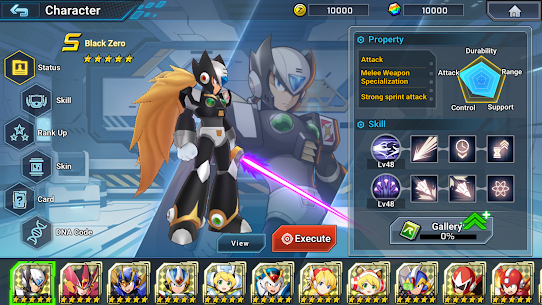
Each Hunter Program is a distinct playable unit with its own stat profile, weapon compatibility, and visual design. Some are faithful recreations of classic Mega Man X characters like X and Zero. Others are original designs or alternate-costume variants created for the DiVE universe. The range of visual and mechanical variety in the roster gives the offline campaign strong replay value even after the main story stages are complete.
How the Offline Version Handles Character Acquisition Without Gacha
In the offline version, Hunter Programs unlock by meeting specific in-game milestones. Clearing certain stage sets, reaching character level thresholds, or collecting designated materials from Deep Log all serve as unlock conditions depending on the character. Because the conditions are fixed and visible, players can plan which Hunter Program to pursue next rather than relying on random drop luck.
That design shift also means the most powerful Hunter Programs require the most gameplay investment to unlock, not the most money spent. Consequently, players who complete the most stages and push into higher difficulty runs will naturally access the strongest characters. The progression curve is steep but transparent.
Leveling Up X, Zero, and Other Hunter Programs
X and Zero are the starting Hunter Programs available from the earliest stages of Deep Log. Both are well-rounded and capable across most of the campaign’s difficulty range. X favors buster-heavy builds with the 360-degree aiming system doing most of the work at range. Zero is stronger in melee range with saber combos that deal high burst damage against Irregular Data bosses.
Leveling any Hunter Program requires running stages with that character active. Experience points do not transfer between characters, so players who want a diverse roster need to actively rotate characters across stage runs. Therefore, choosing which Hunter Programs to level early is a conscious resource decision rather than an oversight.
Which Hunter Programs Work Best at Each Difficulty Level
On normal difficulty, X and Zero clear every stage without issue. Their weapon compatibility is broad, their stats are well-balanced, and the starting skill set covers the full range of combat situations the game introduces in early Deep Log stages. However, on higher difficulties, Irregular Data attacks become faster and hit harder, and generalist builds start to struggle against specific enemy types.
Specialized Hunter Programs with narrow but high-powered weapon compatibility become significantly more effective on harder stages. A character optimized for charged buster attacks clears aerial Irregular Data clusters far faster than Zero’s melee-first kit. Matching the Hunter Program’s strengths to the specific enemy composition of each hard-difficulty stage is the primary skill gap between players who clear hard content efficiently and those who repeatedly fall short.
Stage Progression and Difficulty Levels in Deep Log
Deep Log organizes its hundreds of stages into themed sections, each representing a different era or title from the Mega Man X series. Stages within each section follow a linear unlock sequence. Clearing the current stage opens the next. Boss stages appear at the end of each section and feature high-HP Irregular Data variants with distinct attack patterns not seen in standard stages.
The multi-difficulty structure means every stage is replayable on progressively harder settings after the initial clear. This replayability is the engine that drives late-game progression. Higher difficulty stages are the primary source of weapon rank materials and high-rarity illustration card drops. Players who treat each stage as a one-time clear are leaving significant progression resources on the table.
How the Hundreds of Stages Are Structured Across Deep Log
Each themed section of Deep Log contains between ten and twenty stages, capped by a boss encounter. The section’s enemy roster matches the Mega Man X title being referenced. So stages themed around Mega Man X1 feature different Irregular Data types than those themed around later entries. That variety prevents the combat from feeling repetitive across the full stage count.
Additionally, some stages have secondary objectives beyond simply reaching the end. These include challenges like finishing under a time limit, taking no damage, or defeating a quota of Irregular Data before progressing. Completing secondary objectives rewards bonus materials that standard stage completion does not provide. Pursuing these objectives is optional but efficient for players prioritizing weapon rank progression.
What Changes Between Normal and Higher Difficulty Runs
On normal difficulty, Irregular Data moves at predictable speeds and telegraphs attacks with readable wind-up animations. Players can afford to take a few hits and still clear the stage without issue. On hard difficulty, attack speeds increase, enemy HP scales upward, and the spacing between Irregular Data groups tightens. That removes the breathing room that normal difficulty provides between encounters.
Moreover, harder difficulty runs add elite Irregular Data variants not present in the normal version of the same stage. These elites have unique attack patterns that require the same read-and-react approach used on boss stages. Players who have not developed the habit of reading Irregular Data attack patterns on normal difficulty will find hard difficulty stages significantly harder than the stat increase alone would suggest.
What Full Stage Completion Rewards You With
Completing every stage within a Deep Log section, including secondary objectives and the boss encounter, unlocks a section completion bonus. This bonus delivers a higher-tier material cache than standard stage rewards. Sometimes it includes a guaranteed rare illustration card. These completion bonuses do not repeat on replay, but the standard stage rewards continue delivering materials on every subsequent run.
For players working toward a specific weapon rank threshold, calculating which stages drop the required materials and running those stages on the highest difficulty they can reliably clear is more efficient than clearing new sections on normal. The reward economy in MEGA MAN X DiVE Offline rewards targeted farming over broad progression in the mid-to-late game.
What MEGA MAN X DiVE Offline Players Get Wrong
Most mistakes in MEGA MAN X DiVE Offline come from habits carried over from simpler mobile action games. The game looks approachable with classic pixel-adjacent art, familiar Mega Man X characters, and a straightforward stage structure. However, the power system has enough depth that ignoring any one of its three layers creates compounding difficulty problems as players push into harder Deep Log content.
The three most common errors all involve the same root cause: treating this as a purely action-based game where better reflexes solve every problem. Reflexes matter, but gear optimization and setting configuration matter equally. Players who address both sides of the difficulty equation clear hard content consistently. Those who rely on reflexes alone hit a wall in the mid-game that feels unfair but is actually a gear problem.
Ignoring Card Boosts and Playing Only With Raw Weapon Stats
New players frequently equip the highest-damage weapon available and ignore the illustration card slots entirely. Cards feel passive and secondary compared to the direct damage of a ranked weapon. However, a full card set built around a specific Hunter Program can add equivalent stat value to one or two weapon rank increases. Skipping cards therefore forces players to grind weapon ranks further than necessary to clear the same content.
The fix is simple. After every stage run, check the card inventory and equip any newly dropped cards that improve the active Hunter Program’s weakest stat. That takes thirty seconds and costs nothing. However, players who skip this step for twenty stages find themselves arriving at hard-difficulty boss encounters noticeably under-statted compared to what the game expects.
Rushing Stages Without Banking Weapon Rank Progress
Many players race through normal-difficulty stages to unlock new sections of Deep Log as fast as possible. That produces a wide but shallow progression state with many stages unlocked but weapon ranks lagging behind the difficulty level of new content. By the time a player reaches a section themed around a later Mega Man X title, the Irregular Data health pools require weapon damage output that a low-ranked weapon simply cannot deliver efficiently.
Pacing weapon rank upgrades alongside stage unlocks prevents this bottleneck. A good rule is to rank the active weapon to at least its second skill threshold before advancing to the next Deep Log section. That keeps damage output aligned with Irregular Data health scaling throughout the campaign.
Skipping the Auto-Lock Setting Before Entering Hard Stages
Some players disable auto-lock because it occasionally grabs the wrong target during normal stages, prioritizing a nearby weak enemy over a distant elite. However, entering hard difficulty stages without auto-lock active, and without compensating through manual 360-degree aiming adjustments, is consistently the fastest way to take unnecessary damage from off-screen Irregular Data.
The better approach is to keep auto-lock enabled and override it manually only when a specific targeting decision is needed. Learning to tap a directional input to override auto-lock momentarily, rather than disabling it entirely, is the control technique that separates players who clear hard stages on the first attempt from those who retry them repeatedly.
Best MEGA MAN X DiVE Offline Tips and Tricks for Beginners
How to Set Up Touchscreen Controls Before Your First Stage
Before entering the first Deep Log stage, open the control customization screen and position the jump and dash buttons where the thumbs naturally rest. The 360-degree aiming input works best when the buster fire button is within easy reach of the right thumb without requiring a grip shift. Spending five minutes on this setup prevents the most common early-game frustration: losing stages to control awkwardness rather than difficulty.
Also scale the buttons to a size that allows confident taps without accidentally hitting adjacent inputs. On smaller screens, slightly overlapping buttons create mis-inputs during fast saber and buster combinations. Scaling down the non-essential buttons and leaving the jump, dash, buster, and saber buttons at full size is the configuration most players settle on after trial and error.
When to Prioritize Weapon Rank Over Character Level in Deep Log
Character level and weapon rank both increase Hunter Program power, but they scale differently. Character level increases base stats including HP, defense, and attack gradually across every level gained. Weapon rank delivers concentrated power increases at specific thresholds, particularly when a skill unlock arrives. Therefore, ranking a weapon to its next skill threshold always produces a larger immediate power spike than an equivalent resource investment in character leveling.
The practical implication is that when a stage feels too hard, the answer is almost always weapon rank rather than grinding another character level. Check the weapon rank progress first. If a skill unlock is one or two material sets away, farm the materials and rank up before retrying the stage.
How to Read Irregular Data Attack Patterns Before Committing to a Dash
Every Irregular Data enemy in Deep Log has a readable attack animation that fires before the actual attack lands. On normal difficulty, these animations are slow enough that players can react instinctively. On harder difficulties, the window between the wind-up animation and the attack landing compresses significantly. That requires players to learn the pattern rather than react to it in real time.
The most reliable method is to watch an Irregular Data enemy complete one full attack cycle during the opening seconds of a stage encounter without attacking it. Note the animation that precedes each attack. Then, when fighting that Irregular Data type on a harder stage, players know to dash the moment they see that specific animation. That pattern-reading habit removes most of the randomness from hard-stage encounters.
Frequently Asked Questions About MEGA MAN X DiVE Offline
Is MEGA MAN X DiVE Offline available on both Android and iOS?
MEGA MAN X DiVE Offline is available on both Android and iOS as a paid premium download. The game requires a one-time purchase and runs without an internet connection after installation. It is separate from the free-to-play online version, which requires a live server connection and remains available as a distinct listing on both app stores. Players who want offline play purchase this version specifically.
How many stages does MEGA MAN X DiVE Offline have?
MEGA MAN X DiVE Offline features hundreds of stages organized across multiple Deep Log sections, each themed around a different Mega Man X series title. Every stage is replayable across multiple difficulty levels, which significantly extends the total content available beyond the initial campaign playthrough. Secondary objectives within stages add additional completion goals for players seeking full clears on every run.
What is the difference between MEGA MAN X DiVE and MEGA MAN X DiVE Offline?
MEGA MAN X DiVE is a free-to-play live-service game with a gacha character acquisition system, rotating events, and server-dependent content. MEGA MAN X DiVE Offline is a premium one-time-purchase game where all characters unlock through gameplay. The offline version includes no gacha mechanics and no internet requirement. Players who avoided the online version due to its monetization structure will find this version a straightforward alternative.
Who Should Play MEGA MAN X DiVE Offline
MEGA MAN X DiVE Offline is best suited for Mega Man X fans who want a deep single-player action experience on mobile without gacha systems or server dependency. The side-scrolling action holds up alongside anything else available on Android or iOS in this genre. The 100-plus Hunter Program roster gives the campaign genuine long-term replay value. After spending real time inside Deep Log, learning Irregular Data patterns, ranking up weapons to their skill thresholds, and building out a card set around a favorite Hunter Program, this title earns its place as one of the strongest premium mobile action games Capcom has released. Players who enjoy action games with meaningful gear progression and a roster of iconic characters will find exactly what they are looking for here.
Images
What's new
Various issues fixed.





Latest Games
Popular Games


