
Hellrider 3
| Developer | Andrei Chernyshov |
| Updated | May 20, 2026 |
| Size | 107 MB |
| Version | 1.5 |
| Requirements | 7.1 |
| Get it on |  |
Description
Hellrider 3 opens with a hard hook — demonic bikers ambush you at a roadside gas station and steal your motorcycle before the tutorial ends. This post is for beginners and returning riders who want to move through story mode faster, spend Coins on the right things, and survive the Skeleton King chase sequences without losing progress. You will find a full breakdown of the free-directional riding controls, the Coins and Bullet Drums system, every unlockable motorcycle and character, and the advanced mechanics most players miss. The tips section also covers the one pre-run perk mistake that costs new players hundreds of Coins in the first hour.
Hellrider 3 Overview
Hellrider 3 is a 3D arcade runner built around motorcycle combat, developed solo by Andrey Chernyshov and available free on Android and iOS. The game sits in the same genre as combat-riding titles but takes a sharper approach by combining story-driven levels with an open-throttle control scheme. Unlike lane-switching runners, this title lets players steer freely across the full width of the road — a small design choice that changes every fight.
How the Free-Directional Riding and Combat System Work
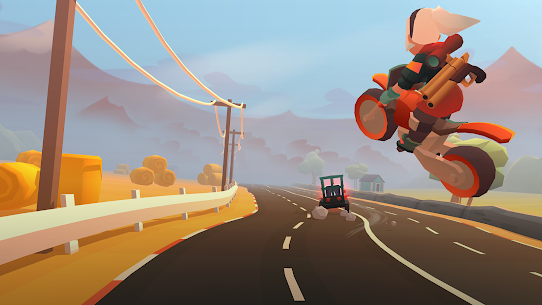
The core mechanic is simple to start and hard to perfect. Players tap the left side of the screen to steer left, the right side to steer right, and both sides at the same time to execute a wheelie. Ammo pickups appear directly on the road — ride over them to collect guns, then drive close to enemies to fire automatically. Bomb throws require a timed tap at the exact moment a target is in range.
Free-directional control is the feature that separates this game from most mobile runners. There are no fixed lanes to switch between. Instead, the player has full lateral movement across the road. This makes it possible to dodge fireballs, cut off enemy bikes, and position for pickups simultaneously. Most new players treat it like a lane game and miss this entirely.
The Story Behind the Gas Station, Demon King, and Demonic Bikers
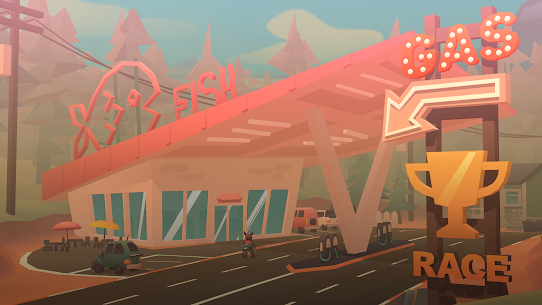
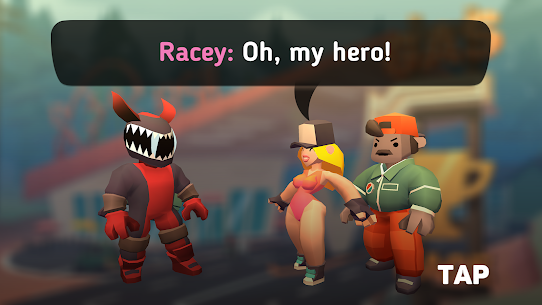
The story begins in the present day. Your character stops at a gas station, and within moments a gang of demonic bikers ride in and take your motorcycle. The gas station owner joins you, and the two of you set out to recover the bike and defeat the Demon King behind the gang. Each level adds new story beats and character rescues, building toward a final confrontation with the Demon King and his lineage.
The tone is wacky and cartoonish. Blocky 3D visuals keep the action readable even at high speed. Obstacles include porta-johns, fireballs, dumpsters, and meteor strikes — all designed to punish riders who stop reading the road. The story mode gives purpose to each run rather than sending players on an endless loop with no context.
How Hellrider 3 Compares to Road Redemption Mobile and Death Moto 3
Road Redemption Mobile is the closest competitor on Android, offering motorcycle combat across longer procedural maps with weapon variety and roguelite runs. Death Moto 3 takes a darker visual approach with PvP-style highway battles. Hellrider 3 sits between these two — lighter and more story-forward than Road Redemption, but more structured and narrative-driven than Death Moto 3’s session-based combat.
The Heroism XP and race gate system also sets this title apart. Road Redemption rewards run length; Death Moto 3 rewards kill streaks. Hellrider 3 rewards race wins and daily challenge completions, meaning progression feels deliberate rather than random. Players who prefer a clear goal every session tend to stick with this game longer.
Motorcycle Controls and Combat System
Touch controls in Hellrider 3 are built for one-handed or two-handed play on any screen size. The system requires no joystick, no tilt, and no complex button combinations. Every action maps to a tap or double-tap on a half of the screen, keeping the interface minimal while the road stays the focus.
Tap Controls for Steering, Wheelies, and Bomb Throws
Left tap turns the bike left; right tap turns it right. Both taps at the same time trigger a wheelie, which gives a short burst of elevation and is essential during the Skeleton King chase sequences. Bomb throws activate with a timed tap when the targeting window opens — the game signals this with a visual cue. Missing the window costs the bomb without dealing damage.
Steering sensitivity increases as the game implements harder challenges at higher levels rather than simply raising speed. However, the density of obstacles — dumpsters, construction equipment, oncoming vehicles — climbs sharply. So tap timing needs to tighten as the story advances, not just reaction speed.
How On-Road Ammo Pickups Feed the Gun and Bomb System
Ammo does not auto-refill between runs. Players collect it by riding directly over pickup icons scattered along the road. Gun pickups enable the automatic firing system, which activates when an enemy is close enough for a hit. Bomb pickups feed a separate charge that the player deploys manually.
The weapon loadout chosen from the garage before a run also affects damage output. Guns like the Duelist deal higher base damage but deplete ammo faster. The Silver and Sting pistol variants are lighter on ammo consumption and suit players who miss pickups frequently. Understanding which gun fits your riding style is one of the faster ways to improve clear times on later story chapters.
What Happens When You Defeat Enemies and Complete an Objective
Defeating enemies drops Coins onto the road. Picking them up before they disappear is part of the combat loop — kill an enemy, steer over the drop, collect, and re-engage the next target. Completing an objective in story mode or race mode triggers a level-end reward screen. This screen shows Heroism XP earned, Coins collected, and any unlock progress.
Reaching a Heroism threshold triggers a race challenge. Winning that race unlocks the next reward tier, which may include a new motorcycle model, character skin, or weapon variant. Losing the race means the reward stays locked until the player earns enough XP for another attempt. This race gate is the main bottleneck in the progression loop.
Game Modes and Daily Challenges
Three game modes give Hellrider 3 its session variety. Story mode is the main campaign. Arcade mode strips the narrative and tests raw riding and combat skills across procedurally generated stretches. Race mode puts the player against bots in a direct competition for first place. Each mode feeds the same Heroism XP pool, so players can advance regardless of which mode they prefer.
Story Mode, Arcade Mode, and Race Mode Explained
Story mode runs through a series of objective-based levels set across a large picturesque world. Each level has a specific task — eliminate a biker gang, escape an obstacle storm, rescue a character, or reach a destination without crashing. Completing a level advances the narrative and adds dialogue from the gas station owner and the characters the player rescues.
Arcade mode removes the objectives and measures distance, kill count, and trick score. It suits players who want a pure test of the free-directional control system without story interruptions. Race mode uses a bot system to simulate competition. The bots scale to the player’s current progression tier, so races stay challenging rather than trivial as the garage improves.
How Daily Challenges Reward Heroism XP and Bonus Items
Daily challenges refresh every 24 hours. Each challenge sets one specific goal — reach a distance threshold, collect a set number of Coins in a single run, defeat a number of enemies using only bombs, or complete a story level without dying. Finishing a daily challenge awards a Heroism XP bonus and additional Coins above the standard run reward.
The daily challenge system is one of the fastest ways to close the XP gap between race gate attempts. Players who skip daily challenges and rely on standard runs take significantly longer to unlock the Revenger or Shark motorcycles. Two or three daily completions per day compress that timeline noticeably.
What the Race Mode Bot System Does for Progression Unlocks
The race mode bot system exists to gate unlocks behind skill rather than time. Every time the player accumulates enough Heroism XP, a race challenge activates. The bot in that race matches the player’s current bike and gear tier, so upgrading equipment does not automatically make the race easier. Strategy and route-reading matter more than raw stats.
Winning the race grants the next unlock in a fixed sequence. However, the Heroism XP earned during the race itself also counts toward future thresholds. This means race attempts are never wasted — even a loss builds toward the next gate. Players who understand this tend to attempt races earlier rather than grinding XP to feel ready.
Characters, Bikes, and Customization
Customization in Hellrider 3 covers three separate categories: character skins, motorcycle models, and guns. All three affect the visual identity of a run. Motorcycle models also affect the feel of handling, though the difference between models is stylistic rather than dramatically stat-driven. Character skins are purely cosmetic.
Unlockable Characters — Billy Morto, Vicky, Duck, Jay, and More
The default character is the Hellrider. Additional skins include Billy Morto, Duck, Hellrider Pro, Mini King, Retro, Vicky, and Jay. Each costs 5,000 Coins in the shop. Vicky is one of the female options, and the game includes both male and female skins across the roster. Outfit skins for each character also appear in the store as additional Coins purchases.
Character unlocks are purely cosmetic and do not affect Heroism XP earnings or combat damage. However, switching to a new skin resets the visual experience of every run, which helps with the repetition fatigue that long-time players mention in reviews. New character models were added in subsequent updates, so the roster has grown beyond the original launch lineup.
Motorcycle Roster — Deadhead, Revenger, Shark, and Golder
The Deadhead is the starting motorcycle. It handles competently across all game modes and carries players well into the mid-game story chapters. The Revenger is the first major unlock target for most players — it offers a sharper visual profile and slightly improved on-road feel. The Shark and Golder follow later and represent top-tier cosmetic milestones.
Some motorcycles require Coins alone; others require Bullet Drums or real-money purchase. The game makes this clear in the garage before any transaction. Players who rely on Coins-only unlocks can access the Revenger and Shark with consistent daily challenge play without spending real money. The Golder may require Bullet Drums depending on the current update version.
Gun Variants — Dandy, Duelist, Silver, Sting, and How to Equip Them
The gun roster includes the Dandy, Duelist, Silver, Pistol, and Sting, among others. Each equips from the loadout screen before a run starts. The Dandy is the starter weapon and performs reliably against early-stage demonic bikers. The Duelist deals higher burst damage but burns through ammo pickups quickly, making it riskier on routes with low pickup density.
The Sting is a mid-range option that balances damage and ammo efficiency. Players who ride aggressively and stay close to enemy clusters benefit from high-damage guns like the Duelist. Players who prefer distance management and rely on bombs for heavy targets do better with the Silver or Sting. Equipping the right weapon before each story chapter makes a clear difference in Coin drops per run.
Coins, Bullet Drums, and the Progression System
Hellrider 3 runs on a dual-currency economy. Coins are the soft currency — earned through every run, race, and daily challenge. Bullet Drums are the premium currency, earned in smaller amounts through gameplay or purchasable directly. Each currency has specific use cases that players need to understand early to avoid costly mistakes.
How Heroism XP and Race Wins Drive the Progression Loop
Heroism XP accumulates from every action in the game — story runs, arcade sessions, daily challenge completions, and race attempts. Reaching specific Heroism thresholds triggers a race challenge. Winning that challenge unlocks the next item in the progression sequence. This loop is the spine of the entire game.
The rate of Heroism gain accelerates when players complete daily challenges alongside standard runs. Grinding story mode alone is the slowest path. Race mode attempts add Heroism even on a loss. Players who rotate across all three modes — story, daily challenge, race — move through the unlock sequence significantly faster than those who stick to a single mode.
What Coins and Bullet Drums Each Buy — and How to Earn Them
Coins buy character skins, motorcycle models within the Coins tier, outfit skins, and standard gun variants. The store prices character skins at 5,000 Coins each. Motorcycles range from 8,000 to 20,000 Coins depending on model. Bullet Drums buy premium motorcycles, skip options during death screens, and accelerate unlocks that are gated behind the premium tier.
Bullet Drums accumulate slowly through normal play. Rewarded video ads offer additional Bullet Drums without payment. However, the daily rate without ad watching or purchase is low. Spending Bullet Drums to continue after a death is the single biggest drain on the premium currency. Save them for motorcycle or weapon unlocks — those purchases persist permanently, while a death continue only extends a single run.
The Perk Cost Warning Every New Player Needs to Know
Before each run, the game offers a perk selection screen. These perks provide bonuses like extra ammo, damage boosts, or obstacle resistance for that single run. Each perk costs Coins to activate. The cost does not appear prominently on the screen, and new players regularly select perks without realizing they have spent Coins rather than earning them.
This is the most common source of stalled progression among early-stage players. A player expecting to earn 500 Coins from a run may actually end it 200 Coins poorer after perk costs and a bad run. Skip the perk screen entirely until the Revenger motorcycle is unlocked and Coins accumulate reliably. Perks become useful later, when the Coin income is high enough that the cost does not disrupt the unlock timeline.
Skeleton King Chase and Advanced Mechanics
Hellrider 3 includes several mechanics that appear without warning and require specific responses. The Skeleton King chase is the most disorienting for new players. The jump-off-vehicle mechanic is the most underused. Together, these features push the game beyond a standard arcade runner into something with genuine tactical depth.
How the Skeleton King Chase Sequence Triggers and What to Do
The Skeleton King appears in specific story chapters and triggers a high-speed chase sequence. The road narrows and obstacle density spikes. The Skeleton King closes distance if the player slows down, crashes into obstacles, or misses ammo pickups. The objective is to maintain speed and distance while dealing enough damage to force the Skeleton King back.
During the chase, bomb timing is more important than gun damage. Bombs deal burst damage that creates separation; guns maintain pressure but do not stop the Skeleton King’s advance on their own. Use the wheelie move to vault over large obstacles instead of steering around them — steering consumes lateral distance and lets the Skeleton King close in. The chase ends when the player deals a threshold of damage or exits the scripted trigger zone.
The Jump-Off-Any-Vehicle Mechanic and When to Use It
The jump-off mechanic lets players launch their character off the top of any vehicle on the road — enemy bikes, cars, trucks, and obstacle vehicles included. Tapping both sides of the screen while alongside a vehicle triggers the jump. The character launches over the vehicle and lands on the road ahead of it, clearing the obstacle and resetting position.
Most players discover this mechanic by accident. However, it is a deliberate design feature confirmed by player reviews and the developer’s own update notes. It proves especially useful in Race Mode when bots block the road or in story chapters with tight corridors packed with construction equipment. Combining the jump-off with free-directional steering creates a fluid movement system that makes Hellrider 3 feel distinct from Death Moto 3 and Racing Fever Moto.
How Free-Directional Control Gives a Tactical Edge Over Lane-Switching Runners
Lane-switching runners like Traffic Rider and Racing Fever Moto lock players into a fixed number of lanes. Hellrider 3 does not. The full-width road movement means players can position diagonally, hug one edge for ammo pickup access, or cut directly through enemy formations. This creates a richer tactical layer without adding complex controls.
The tactical advantage becomes clearest in Race Mode. Bots use standard racing lines, which means a player who cuts off the expected path and positions for a Coin drop or bomb pickup gains an edge that pure speed cannot replicate. Free-directional control also enables the jump-off mechanic — a diagonal approach alongside a vehicle is easier to execute than a perpendicular one. Players who internalize the full-width movement in the first few story chapters carry a permanent advantage into every subsequent mode.
Best Hellrider 3 Tips and Tricks for Beginners
Never Spend Coins on Perks Before Understanding the Heroism Race Gate
Perk selection costs Coins before every run. This deduction happens silently — the game does not confirm the spend with a warning popup. New players focused on the race gate should skip the perk screen entirely until they have at least 15,000 Coins saved. At that point, the cost of one or two perks per run does not disrupt the Revenger unlock timeline. Before that threshold, every Coin spent on a single-run perk is a Coin not building toward a permanent motorcycle unlock.
Use the Wheelie Move During Skeleton King Chases to Gain Burst Distance
The wheelie does not just look good — it vaults the bike over road-level obstacles without triggering a crash penalty. During Skeleton King chases, porta-johns and dumpsters are the most common instant-stop obstacles. Steering around them burns the lateral movement needed to collect bomb pickups. A well-timed wheelie clears the obstacle in a straight line and keeps the Skeleton King from closing the gap. Practice the double-tap timing in story mode long before the Skeleton King sequence appears.
Save Bullet Drums for Motorcycle Unlocks, Not for Death Continues
Spending Bullet Drums to continue after a death is the most common currency mistake in this game. A continue costs Bullet Drums for a single run extension. A motorcycle like the Shark or Golder, purchased with Bullet Drums, stays in the garage permanently and improves every future run. The math is straightforward — permanent assets beat temporary extensions every time. Watch rewarded video ads to build Bullet Drums passively, and hold them until a motorcycle or premium weapon unlock becomes available in the store.
Frequently Asked Questions About Hellrider 3
Is Hellrider 3 Free on Android and iOS?
Hellrider 3 is free to download on both Android via Google Play and iOS via the App Store. The game uses a freemium model — Coins and Heroism XP are earned through normal play, while Bullet Drums are the premium currency available through rewarded ads or in-app purchase. An ad-free version is available as a one-time paid upgrade for players who prefer a cleaner session experience.
How Long Does It Take to Finish Hellrider 3’s Story Mode?
Story mode length depends heavily on how often the player hits the Heroism race gates. Casual players completing one or two sessions per day typically finish the main story arc involving the Demon King in around two to four weeks. Players who complete daily challenges consistently and prioritise race attempts can push through story chapters faster. The game continues beyond the main arc with additional chapters and character rescues added via updates.
Does Hellrider 3 Work Offline?
Yes, Hellrider 3 supports offline play. Players confirmed in reviews that the game runs without an internet connection, making it a strong option for commutes or areas with poor signal. However, rewarded video ads — used to earn Bullet Drums and extra lives — require an active connection to load. Offline sessions still earn Coins and Heroism XP normally.
Final Verdict: Who Should Play Hellrider 3
Hellrider 3 suits players who want more than a lane-switching runner but do not want the complexity of a full racing sim. The free-directional motorcycle combat, Skeleton King chases, and dual-currency progression give it more depth than most free mobile arcade games in this genre. Players who enjoy Road Redemption Mobile or Death Moto 3 will feel at home here, and the offline capability makes it practical for daily sessions anywhere.
The game works best for riders who engage with daily challenges regularly and understand how to protect their Coins. Skip the perks early, hold Bullet Drums for permanent unlocks, and the progression arc stays satisfying from the Deadhead all the way to the Golder. Having put real time into this game personally, I can say the Skeleton King chase sequence is the highlight — nothing in Traffic Rider or Racing Fever Moto matches its mix of pressure and mechanic depth. If you want a mobile arcade rider with genuine tactical layers, Hellrider 3 earns your time.
Images


What's new
New character! The engine has also been updated and the graphics improved.





Latest Games
Popular Games


