
Among The Sleep
| Developer | Snapbreak |
| Updated | Jul 10, 2026 |
| Size | 1.4 GB |
| Version | 1.0.0.0.23 |
| Requirements | 7.1 |
| Get it on |  |
Description
Among the Sleep places you inside the body of a two-year-old child, making every ordinary household space feel enormous, threatening, and deeply strange. This post is written for new players and first-time horror fans who want to feel confident before the first dark chapter begins. The sections ahead cover movement and crawling, Teddy’s light mechanic, the memory system, the symbolic environments, and how to handle the game’s threats without combat.
What Among the Sleep Is and How It Works
Among the Sleep is a first-person psychological horror adventure developed and published by Norwegian studio Krillbite Studio. The game casts the player as a two-year-old child who wakes to unfamiliar sounds in the night. However, what makes this title genuinely distinctive is how the child’s limited understanding of the world shapes every element of the experience — not just the visuals, but the movement, the puzzles, and the horror itself.
There are no combat systems. There are no health bars or scoring. Instead, Krillbite Studio built the horror around atmosphere, sound design, and perspective. Consequently, every environment feels unstable — not because of monsters alone, but because the world seen through a toddler’s eyes is already distorted by size, shadow, and fear.
The game is available in a standard version and the Enhanced Edition. The Enhanced Edition adds improved visuals and an additional DLC museum chapter that runs roughly thirty extra minutes. For any player starting fresh, the Enhanced Edition is the recommended entry point.
How the First-Person Toddler Perspective Defines Gameplay
The camera sits low to the ground. Doorknobs are out of reach. Furniture towers overhead. These are not cosmetic choices — they are the core mechanic shaping every interaction in the game. As a result, players constantly feel small, exposed, and at a disadvantage.
Because of this perspective, standard horror conventions like fighting back or jumping over obstacles do not apply here. Players must think differently. Moreover, even familiar spaces like a kitchen or a living room become labyrinthine when seen from two feet off the floor. That disorientation is deliberate and consistent throughout every chapter.
The Surreal Dream World Setting and Its Emotional Tone
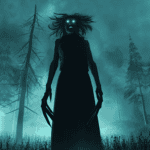
The game begins in a normal home on the child’s birthday evening. However, the world quickly shifts into something surreal and symbolic. Environments morph from household rooms into nightmare versions — twisted forests, flooded basement corridors, and dark maze-like passages that feel both recognisable and deeply wrong.
The tone is melancholic rather than aggressive. Therefore, the horror does not rely on gore or graphic shock moments. Instead, it builds through quiet dread, distorted audio, and the emotional weight of a story that reveals a powerful metaphorical truth about the child’s real home life by the final chapter. Players who expect loud frights may need to adjust their expectations. This game earns its impact slowly.
How This Game Compares to Fran Bow and Limbo on Mobile
On mobile, the two titles most comparable to Among the Sleep are Fran Bow and Limbo, both available on iOS and Android. Fran Bow shares the psychological horror structure and child protagonist but uses a point-and-click format with inventory-based puzzles. By contrast, Among the Sleep delivers the experience through direct first-person movement, creating a more immediate sense of physical vulnerability.
Limbo uses atmospheric horror and dark environments but removes the emotional narrative layer. Additionally, Limbo is a side-scrolling platformer, while Among the Sleep is fully spatial and first-person. For players who want emotional horror storytelling on mobile, Fran Bow comes closest to what this game delivers — but neither mobile title replicates the specific dread of seeing the world from inside a toddler’s body.
How Movement and Crawling Shape Every Decision
Movement in Among the Sleep is not simply a vehicle to reach the next area. It is, in fact, the primary way the game communicates tension. The toddler walks slowly, crawls quickly through tight passages, and can run briefly before falling down. Each mode carries a specific risk-reward profile that players need to understand early.
Crawling is the default state in dangerous or low-ceiling areas. Walking works for open exploration. Running is available but carries a firm penalty — the toddler stumbles and falls after a few seconds of sprinting. Therefore, players who rely on running to escape threats often find themselves face-down on the floor at the worst possible moment.
Walking, Crawling, and the Risk of Running in Dark Corridors
Walking is the standard movement speed in open rooms. It is quiet and stable. Crawling is faster in confined spaces and allows passage under furniture or through narrow openings. Most importantly, crawling is significantly quieter than walking — which makes it the better choice when something is nearby.
Running, however, triggers a fall after a short burst. This makes sprinting useful only as a last resort. As a result, players who panic and sprint frequently make themselves more visible and more vulnerable. The game actively punishes reckless movement. It rewards calm, slow, deliberate navigation far more consistently than speed.
How Interacting with Objects and Doors Works as a Toddler
Because the player character is two years old, standard door handles are out of reach. Players must find and push nearby objects — stools, boxes, small chairs — to climb up and grasp what an adult would reach without thinking. This creates a real sense of physical effort in every room.
Objects in the environment can also be pushed and repositioned independently. However, the game does not highlight these objects or signal that they are needed. Players who rush will miss the solution entirely. Instead, scanning each room carefully and identifying moveable furniture is the key skill that carries through every chapter from beginning to end.
What Happens When You Complete Each Chapter Segment
Each chapter ends when the player places a recovered memory fragment into the memory machine located inside Teddy’s inner world. This triggers a brief visual sequence, and the next chapter begins. The transitions feel like slipping between dream states — seamless and emotionally weighted rather than mechanical.
Additionally, completing a chapter never resets the understanding already built. Therefore, skills learned early — when to crawl, how to use Teddy’s light, and how to position objects near doors — carry forward and become more important as environments grow more threatening in later chapters.
What Teddy Does as Your Companion and Light Source
Teddy is the worn stuffed bear introduced at the start of the game. He speaks to the player, provides emotional comfort, and serves as the primary light source in dark sections. However, his role goes considerably beyond companionship. Understanding how to use Teddy effectively is one of the most practical skills in the entire game.
Pressing the hug button causes the toddler to embrace Teddy. When this happens, Teddy emits a soft, warm glow that illuminates the immediate area. This is the only reliable light source for most of the experience. Therefore, knowing when to use that light and when to move without it is a key tactical decision — not just an emotional one.
How Teddy Emits Light When You Hug Him
Holding and hugging Teddy produces a steady amber glow. It reaches roughly two to three meters in any direction, which is enough to identify obstacles, check corners, and locate items in a dark room. The light does not alert monsters or trigger any negative effect — it is purely beneficial.
However, the hug animation requires the player to slow down slightly. Moving at full speed while maintaining Teddy’s light is not possible. Consequently, players must balance speed against visibility in threatening sections. In calm areas, use the light freely. In urgent situations, the choice becomes more difficult.
How Teddy Communicates Story and Guides Your Direction
Teddy speaks periodically throughout the game. His dialogue provides directional hints, emotional context, and subtle clues about what each surreal environment represents. Players who listen carefully will find that his words often point toward the next objective or toward the emotional core of that chapter.
By contrast, players who rush forward without attention to Teddy’s dialogue will sometimes feel genuinely lost. Furthermore, Teddy’s tone shifts noticeably in threatening situations. His voice becomes quieter, more urgent. This functions as a reliable early warning that the player should slow down, switch to crawl mode, and look for cover before moving further.
When to Use Teddy’s Light Versus Moving in the Dark
In open and visually clear spaces, moving without light is faster and carries less risk. However, in narrow corridors, unfamiliar rooms, or any area with unusual audio, hugging Teddy for light is always the more reliable choice. A few seconds of illumination often prevents walking into a dead end — or into a threat that has not been spotted yet.
A practical approach is to use Teddy’s light at the entrance of every new room. Scan the space, identify exits and objects, then move. This method consistently prevents wasted time backtracking through dark hallways. It also reduces the emotional panic that comes from realising a threat is close with no clear exit already memorised.
How Atmosphere and Sound Build the Horror in Each Chapter
Krillbite Studio built Among the Sleep on a specific design principle: horror through atmosphere rather than action. The sound design is the most important element of that principle. Each environment has its own acoustic profile — floorboards creaking, distant water dripping, something moving just beyond the visible edge of the room.
These audio cues are not background decoration. They signal transitions, proximity to threats, and key story moments. Players who wear headphones will notice significantly more detail than those using speakers. As a result, headphones are not just recommended — they meaningfully change the depth of the experience.
How Eerie Sound Design Shapes Each Environment
Each chapter uses a distinct soundscape to communicate its emotional tone. Some areas hum with the mechanical noise of household appliances. Others carry the unsettling sound of running liquid. Outdoor sections feel exposed through wind and the conspicuous absence of comforting domestic sound.
Sound also functions as a proximity signal for threats. Monsters make audible movement before they become visible. Therefore, attentive players can react to audio cues before a visual threat appears. Listening is an active gameplay mechanic here — not passive background noise. Players who stop moving and simply listen before entering unknown spaces will consistently make better decisions than those who rely only on what they can see.
What the Surreal Environments Symbolize Beyond the Surface
Most horror games use surreal environments purely for visual impact. However, Among the Sleep uses them as direct metaphors for the child’s emotional reality. Each distorted space represents a real location from the child’s life, warped by fear, confusion, and the trauma of witnessing parental instability over a sustained period.
The flooded, swamp-like environment connects to the mother’s alcoholism through the recurring motif of dark, uncontrollable liquid that appears throughout those sections. Players who pay close attention to environmental details — child’s drawings on walls, scattered household objects, furniture positions — will recognise a deeper narrative running beneath the horror surface. These details recontextualise every chapter when the game’s final revelation lands.
How Krillbite Studio Built Tension Without Combat Systems
Most horror games give the player at least one tool of resistance — a flashlight, a weapon, or a sprint button without consequence. Among the Sleep removes all of these conventions deliberately. Players have no way to fight back. The only available responses to a threat are hiding, moving quietly, or running until the toddler falls.
This design choice amplifies tension precisely because failure is not purely mechanical. Being caught returns players to a nearby checkpoint. However, the feeling of helplessness does not diminish over time. Because the player never becomes stronger, faster, or better equipped, the tension remains present in every chapter — something rare in horror games, where players typically grow more confident as they progress.
What the Memory System and Progression Unlock
Progression in Among the Sleep is structured entirely around memory fragments. Each chapter contains a key memory — a fragment of the child’s real life, seen through the child’s imagination. Players recover these memories during exploration and return them to Teddy’s inner world, where they are placed into a machine that advances the story.
The memory system is simultaneously a mechanical structure and a narrative device. Each recovered memory reveals a piece of the child’s home life. Consequently, collecting every memory is not optional in any meaningful sense — it is the central activity of each chapter and the only way to reach the game’s conclusion.
How the Memory System Advances the Story
Each memory fragment appears as a glowing object within the chapter environment. Picking it up triggers a short visual sequence — a moment from the child’s real life, filtered through a toddler’s limited comprehension. These moments are quiet, emotional, and intentionally ambiguous on first viewing.
After completing all chapter objectives, the player returns to Teddy’s inner world through a wardrobe portal. There, the memory is placed into the machine, which opens the path to the next chapter. The process is linear in structure but paced to feel like an emotional journey. It never feels like a mechanical loop because the memories themselves carry genuine weight.
What Hidden Memory Fragments Are and Where to Find Them
Beyond the main memory of each chapter, the game contains optional fragments placed in less obvious locations. These smaller glowing objects appear tucked behind furniture, inside low containers, or in rooms players might bypass entirely if moving quickly. Collecting these optional fragments does not change the ending but adds meaningful context to the story.
Players who rush each chapter will miss these fragments. Therefore, the most reliable approach is to check every room thoroughly before moving toward the chapter’s primary objective. Interactive objects tend to sit at low heights — drawers, floor-level boxes, small open shelves — because the player character is a toddler and cannot interact with anything placed at adult height.
What Completing the Memory Journey Unlocks
Completing all chapters and collecting all core memories leads to the game’s final sequence inside Teddy’s inner world. That conclusion reveals the full truth of the child’s home situation in a way that recontextualises every surreal environment encountered throughout the game. The ending is not a twist for its own sake — it is the logical arrival point of a carefully constructed metaphorical narrative.
Additionally, the Enhanced Edition includes the DLC museum chapter accessible after completing the main story. This chapter presents concept art, original story directions the developers considered, and production materials. It runs roughly thirty minutes and is particularly valuable for players who want to understand the symbolic choices behind each environment.
How the Toddler Perspective Changes Every Horror Moment
The toddler perspective is not a stylistic choice. It is the structural foundation of every horror moment in the game. Because players are physically small, the world is constantly disproportionate — ceilings are high, furniture blocks sightlines, and every shadow hides more than it would at adult height.
Most horror games create fear by threatening the player with a superior enemy. Among the Sleep creates fear by making the player inherently and permanently vulnerable. There is no level-up mechanic, no equipment slot, no skill progression. Therefore, the tension never decreases because the player never becomes more capable. That persistent vulnerability is the game’s single most powerful design choice.
Why Crawling Feels Faster and Safer Than Walking in Tight Spaces
Crawling covers ground quickly through tight passages and underneath furniture. It also lowers the player’s visual profile, making detection harder. Furthermore, crawling is quieter than walking — which consistently reduces the chance of attracting attention in dangerous areas.
Players who default to walking in all situations often struggle in the mid-game chapters, where tight corridors and pursuing threats require fast, quiet movement together. Switching to crawl mode early and using it as the default in enclosed spaces is one of the most practical habits a new player can establish. This single adjustment eliminates a large proportion of the frustration that first-time players report.
How Door Handles and Furniture Heights Create Real Tension
In the kitchen and living room sections, many doors cannot be opened without first repositioning a nearby stool or chair. This creates a puzzle layer unique to the toddler mechanic. Every door becomes a potential obstacle — not because it is locked, but because it is simply too high to reach without effort.
This tension compounds when something is close. The instinct is to run through a door. However, the toddler cannot reach the handle without climbing. Therefore, players who have not already moved the nearby chair must pause, find it, reposition it, and climb — all while a threat draws closer. Players who scan rooms proactively and prepare exit routes in advance experience this moment as manageable rather than catastrophic.
What Most Players Miss About Running and the Fall Mechanic
Running in Among the Sleep feels fast and reassuring for the first two to three seconds. Then the toddler’s legs give out and the player falls to the ground. Recovery from that fall takes approximately two seconds — long enough for a pursuing threat to close significant distance.
Players who use running in short, controlled bursts — to cross open spaces before dropping back to a crawl — will find it more useful than players who sprint blindly in panic. Additionally, running through a known clear area is far safer than running in a space that has not been checked with Teddy’s light first. Speed without information is consistently more dangerous in this game than moving slowly through a known environment.
Best Among the Sleep Tips and Tricks for Beginners
The most important thing to understand before starting is that Among the Sleep rewards patience consistently. These Among the Sleep tips apply across the full game because the core loop — observe, illuminate, move carefully — never changes, even as the environments grow more complex. Speed helps in very few situations. Careful observation helps in all of them.
New players tend to make the same early mistakes. They run past objects they should push. They forget to use Teddy’s light in unfamiliar rooms. Additionally, they panic when threats appear and sprint without knowing what is ahead. Each of these mistakes is avoidable with a small amount of deliberate preparation.
How to Use Teddy’s Light to Avoid Walking Into Dead Ends
In every new room, pause at the entrance. Hug Teddy immediately and scan the full space before taking a single step forward. This takes roughly five seconds. It identifies every exit, every interactive object, and any threats already present in the room. As a result, players avoid walking blindly into dead ends and then backtracking through the dark, which wastes time and amplifies anxiety unnecessarily.
This habit is especially important in the later chapters, where rooms become more complex and threats more frequent. Furthermore, knowing the layout of a room before moving through it means that when a threat does appear, the player already knows exactly where to go — removing the most dangerous kind of hesitation.
Why Collecting Every Memory Fragment Early Prevents Confusion Later
Optional memory fragments scattered throughout each chapter add context to the story’s central metaphor. Players who skip them during early chapters often find the final revelation less emotionally coherent. Collecting every fragment early builds a complete picture of the child’s home life, making the ending considerably more powerful.
Additionally, fragments appear at floor level — under furniture, in low containers, on small open shelves. Because the player character is a toddler, objects placed at adult height are almost never interactive. Therefore, focusing attention on floor-level items in every room is the most efficient and accurate search approach for anyone wanting to experience the full narrative.
How to Survive Monster Encounters Without Freezing Up
When a threat appears, the instinct is to freeze or sprint. Both responses tend to make the situation worse. Instead, the most reliable survival approach is to switch immediately to crawl mode, move toward the nearest piece of large furniture, and stop moving entirely. Stillness and low positioning are more effective than speed in almost every threat encounter in the game.
The game’s monsters respond primarily to sound. Running footsteps and loud movement attract their attention faster than anything else. Consequently, stopping all movement while crouched behind or underneath furniture is often enough to remain undetected. Most encounters become manageable once players understand that silence — not speed — is the primary tool of survival throughout the entire experience.
What Players Ask About Among the Sleep
How long does Among the Sleep take to beat?
Among the Sleep takes approximately three to four hours to complete on a first playthrough. Players who search every room and collect all optional memory fragments may take five to six hours. The Enhanced Edition adds a DLC museum chapter extending total playtime by roughly thirty minutes. The game is designed as a single-session experience and plays best without extended breaks between chapters.
Is Among the Sleep scary for players who avoid jump scares?
Among the Sleep does include a small number of jump scares, but the game’s primary horror is atmospheric rather than shock-based. Tension builds through sound, the toddler’s physical vulnerability, and the emotional weight of the story. Players sensitive to sudden startles will encounter a few moments, but these are not the game’s dominant method. The overall mood is persistently unsettling rather than relentlessly intense.
What platforms is Among the Sleep available on?
Among the Sleep is available on Windows, macOS, and Linux via Steam and itch.io. The Enhanced Edition is available on PlayStation 4, Xbox One, and Nintendo Switch. The console Enhanced Edition is the most complete release and includes improved visuals and the DLC museum chapter. There is currently no official standalone mobile version for Android or iOS.
Why Among the Sleep Is Worth Every Uncomfortable Minute
Among the Sleep is best suited to players who value emotional storytelling and atmosphere over action and mechanical progression. The experience is short — around three to four hours — but that brevity is a deliberate strength. Every moment is purposeful. The toddler perspective creates a kind of vulnerability that most horror games are simply unable to replicate through any other design approach. Having played through the full game, the ending genuinely reframes every uncomfortable moment that came before it in a way that stays with you long after the credits. Among the Sleep is not the loudest or most mechanically complex horror experience available. It is, however, one of the most affecting. Players who want horror that respects their intelligence and leaves something meaningful behind will find this title fully delivers on that promise.
Images



Latest Games
Popular Games


