
Towaga: Among Shadows
| Developer | Noodlecake |
| Updated | Jun 2, 2026 |
| Size | 274 MB |
| Version | 1.5.3 |
| Requirements | 7.0 |
| Get it on |  |
Description
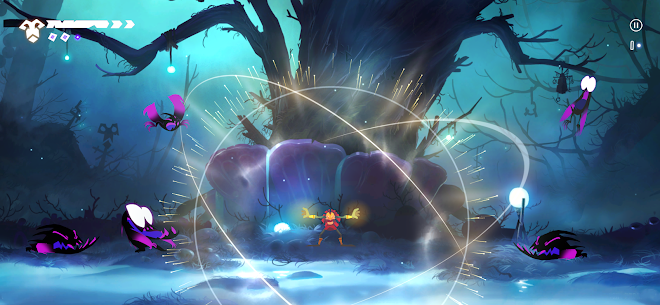
Towaga Among Shadows puts players in the role of Chimù, an ancient warrior who fires a continuous light beam in a 360-degree arc to destroy waves of shadow creatures attacking from every direction. This breakdown is written for new players picking up the game on Android or iOS for the first time. The sections below cover the light beam system, all four game modes, the spell roster, enemy types, and the Void Crystal upgrade path.
What Is Towaga Among Shadows and How Does It Play
Towaga Among Shadows is a 2D arcade action game developed by Sunnyside Games and published by Noodlecake Studios. Players control Chimù, a masked warrior of light, who stands fixed in position while waves of shadow creatures attack from every angle. The core goal is to survive each phase by sweeping the light beam across incoming enemies until the wave clears.
The game launched on Apple Arcade in 2019 and became available as a standalone title on the App Store and Google Play in June 2023. It is a premium release priced at $2.99, with no in-app purchases affecting gameplay balance. The visual style draws heavily from animated films, using vibrant colors against silhouetted enemies for a striking contrast.
How the light beam combat system works
Chimù fires one continuous beam of light from his hands. Players aim this beam using a virtual joystick on the left or right side of the screen. The beam sweeps in a full 360-degree arc across the 2D plane and damages every enemy it touches. Small enemies die quickly. However, larger enemies require the beam to remain focused on them for a longer time before they fall.
In addition to the basic beam, players unlock spells that activate as secondary burst abilities. Each spell has a cooldown timer controlled by Chimù’s mana recovery rate. Therefore, managing beam rotation and spell timing simultaneously is the central skill this title builds across its 70-plus levels.
The Az’Kalar story, Chimù, and the Legion of Darkness
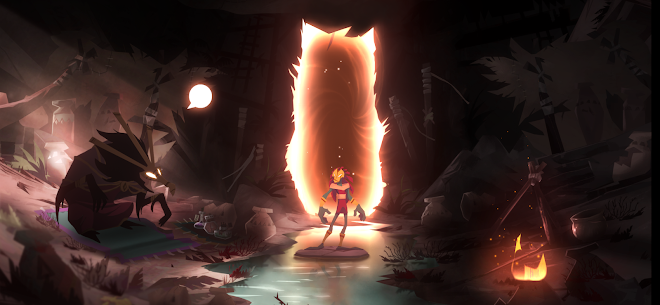
The story follows Chimù, a guardian tasked with purifying ancient temples corrupted by Metnal the Voidmonger. Metnal leads the Legion of Darkness, a massive force of shadow creatures set on consuming the island. The Az’Kalar are the ancient civilization whose history Chimù uncovers through lore artifacts and entries in Ikal’s Diary as progress is made through Story Mode.
The narrative is told through collectible text items rather than cutscenes. Players find artifacts and codex entries tied to specific level completions. Consequently, the story rewards players who push through all 70-plus levels, because the full history of the Az’Kalar only becomes visible across multiple sessions.
How Towaga Among Shadows compares to Archero and Shadow Fight 2 on mobile
Archero and Shadow Fight 2 are the two most prominent mobile action titles in the same player audience bracket. However, the difference in core structure is significant. Archero uses free movement across rooms, with players dodging and repositioning constantly. This title keeps Chimù stationary, so the challenge shifts entirely to beam accuracy and spell timing rather than spatial navigation.
Shadow Fight 2 focuses on one-on-one melee combat with an extensive martial arts move set. By contrast, this mobile action game is a wave defense shooter where crowd control and area denial matter more than precise strikes. Players who enjoy the pressure of managing dozens of enemies simultaneously will find it a stronger fit than either of those titles.
How Controls and Combat Phases Work in Towaga
Each level is divided into multiple phases. A phase is a single wave segment that players must clear before the next begins. Completing all phases in a level progresses the story and awards shards for upgrading. The game alternates between two distinct combat stances across different phases.
Understanding the difference between ground phases and flying phases is important from the start. New players sometimes assume the entire game plays identically. It does not. The two phase types demand completely different approaches to positioning and spell use.
How the 360-degree light beam rotates in ground phases
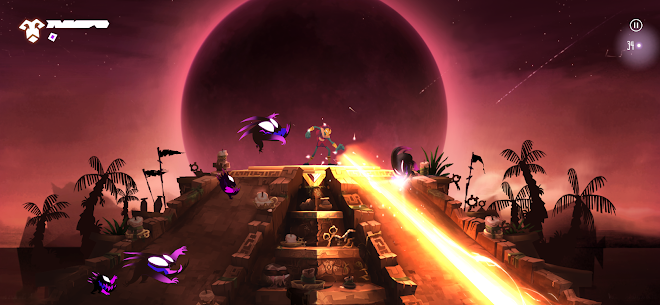
In ground phases, Chimù stands fixed on top of a temple. The player rotates the light beam around Chimù in a full circle using the on-screen joystick. Enemies approach from every direction simultaneously, so the beam must sweep constantly to prevent any single enemy from reaching Chimù. The closer an enemy gets, the faster players must prioritize it.
Shards collected between phases allow players to increase the beam’s width, which makes clearing dense clusters faster. Additionally, a wider beam reduces the precision players need when enemies arrive from multiple angles at once. This upgrade is the most impactful early purchase in the progression system.
How flying phases switch Chimù into a free-movement shoot-em-up
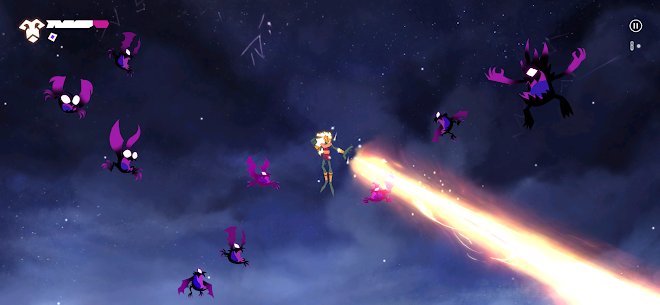
Flying phases remove the fixed-position constraint entirely. Chimù takes to the air and the game briefly becomes a vertical shoot-em-up where players move freely across the screen. The light beam fires in the direction of movement rather than rotating in a circle. However, spells are unavailable during flying phases, which removes a key defensive tool.
These aerial sections appear at specific story junctures, usually after Chimù has cleared the ground sections of a temple. Because spells are locked out, players rely entirely on movement and beam accuracy during flying phases. This makes aerial segments feel more demanding for players who have become reliant on Wind Gust or Lava Slugs in ground combat.
What happens when all enemies in a phase are cleared
Clearing all enemies in a phase ends the wave and triggers a brief recovery window. During this window, Chimù regains a portion of health and any mana players used for spells begins recovering toward full. The game then presents the next phase or, if the level is complete, awards shards and moves to the upgrade screen.
Boss encounters appear at the end of certain levels and do not follow the standard wave format. Instead, a single powerful enemy enters the arena with a unique attack pattern. Therefore, players who cleared all earlier phases with full spell charges will hold a meaningful advantage when the boss phase begins.
How Spells and Upgrades Shape Your Power
Spells are secondary abilities that activate on command alongside the main light beam. Players unlock them progressively by spending shards through the upgrade menu. Each spell serves a different combat purpose, and the best spell choices depend heavily on which enemy types appear most in the current level set.
More than fifteen spells exist across different magic schools, and each has four upgrade tiers. However, not all spells perform equally in practice. Experienced players consistently identify two or three spells as genuinely decisive in harder phases, while the rest serve more situational roles.
How each spell targets a specific enemy class
Wind Gust fires a radial burst that pushes all nearby enemies away from Chimù. This spell counters Swarmers, the fast-moving close-range enemies that arrive in large numbers. By contrast, the ice beam freezes individual enemies in place, which works best against tanky Wreckers that absorb extended beam fire before falling.
Lava Slugs sends a burning projectile outward that deals damage over time to foes it contacts. This spell is best against Bombers and Casters who stay at range and attack with projectiles. Additionally, the petrification shockwave turns every nearby enemy to stone, creating a brief window where the beam can work through clustered groups without pressure.
How Wind Gust, Lava Slugs, and the petrification shockwave each function
Wind Gust is the first spell players unlock and remains effective throughout the entire game. It activates instantly and pushes enemies back across the full radius around Chimù. Because it requires no targeting, it functions as a panic button when the screen becomes too crowded. Most experienced players keep it equipped at all times.
Lava Slugs fires in a fixed direction and travels outward before detonating. The burn effect continues damaging enemies for a short time after contact. Similarly, the petrification shockwave affects all enemies within range regardless of direction, making it the strongest area-denial tool in the spell roster. Both spells reward players who upgrade mana recovery early, since each carries a meaningful cooldown.
How spell upgrade levels change what each ability does
Each spell has four upgrade tiers players purchase with shards. The first tier unlocks the base spell. Subsequent upgrades increase radius, damage, or cooldown reduction depending on the spell type. For Wind Gust, tier upgrades increase the distance enemies travel when pushed back. For Lava Slugs, they extend the burn duration.
Upgrading spells from tier one to tier two produces the most noticeable change. The jump in effectiveness between tiers three and four is smaller. Therefore, spreading upgrades across two or three spells at tier two is more efficient than pushing one spell to tier four before using others.
How Enemy Variety Forces Smarter Play
This action game features six distinct enemy classes that appear in later levels in combination. New players often struggle not because the beam is underpowered but because they apply a single strategy to every enemy type. Understanding what each class does is the fastest way to survive harder phases without upgrading further.
Each enemy class enters from a specific direction and behaves differently once in range. Some target Chimù directly. Others attack with projectiles or create zone effects that restrict the space available for beam rotation. Recognizing each type on entry is a skill that develops across the first twenty levels.
How Swarmers, Bombers, and Wreckers each demand a different response
Swarmers are fast, small, and arrive in large groups. They close the distance quickly and punish slow beam rotation. Players should sweep the beam continuously in the direction the swarm enters from. Wind Gust is the best spell backup if a cluster breaks through.
Bombers stay at range and fire explosive projectiles at Chimù. Because they do not rush in, players sometimes ignore them while focusing on Swarmers. However, projectile damage accumulates quickly when multiple Bombers are active. Prioritizing Bombers before Swarmers is the safer play in mixed-entry phases.
Wreckers are large, slow enemies with high health. The light beam must remain locked onto a Wrecker for several seconds to bring it down. Meanwhile, players cannot ignore other enemies entering from opposite directions. This forces a split between holding the beam on the Wrecker and briefly sweeping to intercept faster enemies.
How Warpers, Constrainers, and Casters punish passive players
Warpers teleport unpredictably across the screen, making beam tracking difficult. Players who sweep the beam slowly will consistently lose contact with a Warper before dealing enough damage. The solution is rapid, short arc sweeps to re-acquire the Warper after each teleport.
Constrainers create zone effects that reduce the available movement space in ground phases. This forces the beam to work within a narrower arc while other enemies continue arriving. Consequently, phases that include Constrainers require players to save spells specifically for the moment a zone effect activates.
Casters fire multiple projectiles and stay behind other enemies as a backline threat. Because other enemies protect them, Casters often survive longer than any other class in a wave. Targeting Casters early, before their projectile output builds up, is the correct approach in phases where they appear alongside Swarmers.
How boss encounters at the end of each level phase work
Boss encounters replace the standard wave format and place a single powerful enemy in the arena with a unique attack pattern. Bosses take significantly more beam time to defeat than standard Wreckers. Moreover, they use special attacks that do not appear in regular phases.
Metnal the Voidmonger is the primary antagonist and appears as a story boss at the conclusion of Story Mode. Reaching him in good condition depends on how well players distributed Void Crystal upgrades across beam power and health in earlier levels. Players who conserved mana during the final phases before his encounter will have spell charges ready when his attack pattern begins.
How Progression and Void Crystals Power Up Chimù
The upgrade system separates into two resources: shards and Void Crystals. Shards are small currency units awarded at the end of every phase. Void Crystals are rarer and awarded for completing full levels and challenge objectives. Each resource purchases different categories of upgrades.
Understanding which resource to spend on which upgrade category is the central strategic decision in the game. New players often spend both currencies randomly, which results in a character who is partially upgraded in several areas but dominant in none. Therefore, planning purchases from the first session forward produces a noticeably stronger Chimù by mid-game.
How Void Crystals and shards are earned and spent
Shards drop after every phase completion regardless of performance. Void Crystals require a full level completion or a specific challenge objective. Both currencies are spent through the same upgrade menu, but they access different upgrade tiers. Shards purchase base upgrades for health, beam size, and mana recovery. Void Crystals unlock spells and higher-tier improvements.
Playing the additional modes beyond Story Mode earns Void Crystals at a faster rate. Survival Mode, Void Realm Mode, and Challenge Mode all award Void Crystals on completion. Therefore, players who feel underpowered in Story Mode should attempt the additional modes to accelerate their upgrade curve.
How health, beam size, and mana recovery upgrades change survivability
Health upgrades increase the number of hits Chimù can absorb before the phase fails. Beam size upgrades widen the arc of the light beam, reducing the precision players need to hit fast-moving enemies. Mana recovery upgrades decrease the cooldown time between spell uses.
Each of these three upgrade categories affects survivability differently. Health is a safety net. Beam size changes how often enemies pass through undetected. Mana recovery determines how frequently Wind Gust and other key spells are available. For most players, beam size offers the highest return on early shard investment.
How story artifacts and Ikal’s Diary entries unlock lore
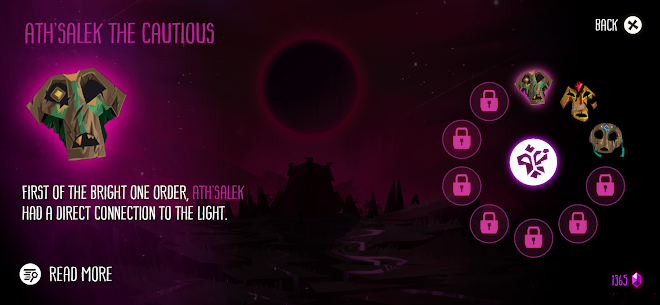
Story-driven artifacts unlock automatically when players complete specific levels. They appear in the menu as collectible text items detailing the history of the Az’Kalar civilization. Ikal’s Diary is a separate sequence of entries that reads like a first-person account of the events leading up to Metnal’s rise.
These lore items do not affect gameplay directly. However, they are the primary vehicle for the game’s narrative. Players who skip the artifact texts will complete Story Mode without understanding why Chimù is fighting or who the Az’Kalar were. Reading them between level attempts adds meaningful context to the boss encounters in the later stages.
Best Towaga Among Shadows Tips and Tricks for Beginners
How to rotate the light beam ahead of enemy movement paths to intercept
New players instinctively sweep the beam toward where enemies already are. This reactive approach consistently results in enemies reaching Chimù before the beam arrives. Instead, players should rotate the beam ahead of the direction enemies are moving, not toward their current position.
This technique requires anticipating the path a cluster of Swarmers or a flying enemy will take based on its entry angle. The beam covers a wider arc when moving continuously. Therefore, keeping it in motion at all times — rather than locking it onto one enemy — clears more threats per second across a full phase.
How to prioritize Void Crystal spending on beam size before mana recovery
The temptation early in the game is to unlock as many spells as possible. Spells are immediately exciting and feel powerful on first use. However, a narrow beam misses enemies even when aimed correctly, because small enemies pass through gaps the beam does not cover.
Investing the first two or three Void Crystal upgrades entirely into beam size produces a noticeable improvement in phase survival rate. After beam size reaches its second upgrade tier, the coverage difference is significant. Mana recovery upgrades become the stronger next purchase after beam size is established.
How to use Wind Gust to reset the screen when Swarmers overwhelm Chimù
Wind Gust is the only spell that requires no targeting and activates instantly. This makes it uniquely useful in moments when the screen fills with Swarmers from multiple directions simultaneously. Activating Wind Gust pushes everything nearby back to the screen edge, creating a two to three second window where the beam can re-establish coverage.
Many players save Wind Gust for boss fights or difficult phases. However, its greatest value is as a reset tool in standard Swarmer-heavy phases. Using it early when the screen first becomes crowded — rather than waiting until Chimù is at low health — prevents the cascade damage that typically ends a run.
Frequently Asked Questions About Towaga Among Shadows
Is Towaga Among Shadows available on Android?
Towaga Among Shadows is available on Android via Google Play as of June 2023. The game was originally exclusive to Apple Arcade when it launched in 2019. Noodlecake Studios published the wider release across the App Store and Google Play simultaneously. The Android version is a premium purchase at $2.99 with no additional in-app purchases needed to progress.
How many levels does Towaga Among Shadows have?
Towaga Among Shadows features more than 70 unique levels spread across Story Mode and its additional modes. Story Mode contains the main campaign. Survival Mode, Void Realm Mode, and Challenge Mode add separate level structures beyond the campaign. Each level contains multiple phases, so the total number of individual combat encounters players face is significantly higher than 70.
Does Towaga Among Shadows have multiplayer?
Towaga Among Shadows includes a versus multiplayer mode available in flying phase format. Two players compete while a closing death mist narrows the arena around them. The game also features global leaderboards tied to Challenge Mode performance, allowing players to compare scores worldwide. Local co-op is not available in the mobile version.
Why Towaga Among Shadows Is Worth Your Time Right Now
Towaga Among Shadows is the right game for players who want tight, focused arcade action on mobile without gacha mechanics or energy timers. The light beam system is genuinely original — no other mobile action title in the same price range puts players in a fixed-position, 360-degree combat scenario with this level of spell depth. Having played through Story Mode and spent real time in Void Realm Mode, the progression curve feels fair and the spell roster provides enough variety to keep each run feeling different. Players who enjoy mastering a narrow, high-skill mechanic will find this title deeply satisfying. At $2.99, it stands as one of the strongest-value premium action games on Android and iOS today.
Images
What's new
Minor bug fixes and improvements



Latest Games
Popular Games


