
Off The Road: OTR
| Developer | DogByte Games |
| Updated | May 18, 2026 |
| Size | 552 MB |
| Version | 1.18.2 |
| Requirements | 5.0 |
| Get it on |  |
Description
Off The Road (OTR) puts 55 driveable vehicles in one open-world sandbox — and lets you switch from a muddy 4×4 to a helicopter without loading a new map. This post is written for mobile sandbox fans who want to understand every system before spending their first coin. Here you will find a full breakdown of the winch mechanics, the card pack progression loop, the construction features most players ignore, and the key tactics that separate new drivers from experienced ones. By the end, you will know exactly how the multi-vehicle traversal loop works and where beginners waste their early coins.
Off The Road OTR Overview
Off The Road is a mobile open-world simulator developed by Dogbyte Games — the same team behind Offroad Legends 2 and Zombie Offroad Safari. The game has crossed 100 million downloads on Android alone. That number reflects something real: OTR offers a layered sandbox driving experience that most mobile offroad titles cannot match.
The core loop is simple on the surface. Players drive vehicles across varied terrain, beat challenges, earn coins, and unlock new cars through card packs. However, the depth comes from how the systems connect. The winch mechanic, the construction mode, and the multi-vehicle switching all feed into each other in ways that take time to see clearly.
What the open-world driving simulator does differently
Most mobile offroad titles keep you in one vehicle type on one map. OTR breaks that model. Players can get out of a 4×4, walk across terrain on foot, board a boat, and take off in a helicopter — all within a single session.
The simulation layer is also unusually detailed for a mobile title. Tyre pressure responds to load and terrain type. Vehicle chassis deform on impact, so crashes leave visible damage. The dynamic mud deformation means soft ground changes shape as tires pass through it. These are not cosmetic touches — they affect how vehicles handle.
The setting, terrain variety, and tone of OTR
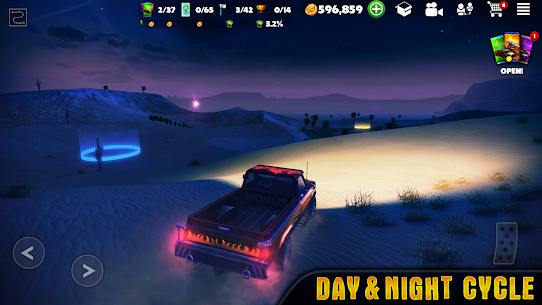
The open world includes hills, islands, muddy fields, water bodies, and elevated mountain terrain. A dynamic day-night cycle shifts the atmosphere without interrupting play. The tone is more adventure-exploration than pure racing competition.
However, competitive elements are present. Weekly Ranked Race events put players against others globally. The sandbox mode sits alongside structured challenges, so both exploration-focused and objective-focused players find a space that suits them. The result is a tone that sits between a relaxed open-world sim and a competitive event platform.
How OTR compares to Offroad Outlaws and Offroad Legends 2 on Android
Offroad Outlaws is the most direct competitor in terms of open-world off-road driving on Android. It offers strong vehicle customisation and multiplayer, but it limits vehicle types to land-based options. OTR extends that with boats, helicopters, airplanes, and trains in the same world.
OTR 2 — also from Dogbyte Games — focuses on structured obstacle tracks rather than open exploration. That makes it tighter and more skill-gated. OTR trades some of that precision for scale and variety. Players who prefer freedom over track-based progression will find OTR more rewarding. Those who want clearly defined skill challenges may prefer Offroad Legends 2 for shorter sessions.
Gameplay Mechanics and Controls in OTR
The control system in OTR uses on-screen buttons for steering, throttle, and braking. Players can adjust these in settings, and camera modes can be toggled between third-person, cockpit, and free-look. Getting comfortable with the camera toggle early makes terrain reading much easier.
Vehicle handling varies significantly between the 55 available vehicles. Light 4×4 trucks respond quickly and suit mountain terrain. Heavier trucks carry more cargo but require wider turns and earlier braking. Boats handle with momentum-based steering, so players need to plan routes rather than react. Helicopters give full vertical control and are the fastest way to scout unfamiliar terrain.
How driving physics, tyre pressure, and damage work
Tyre pressure simulation means soft ground compresses tires visually and affects grip. Overloaded vehicles — particularly during transport challenges — handle differently from empty ones. Players who ignore this during cargo runs often find themselves stuck on inclines that feel manageable with an empty truck.
The damage model deforms the chassis on impact. Falls from height and hard crashes bend the vehicle body visibly. Driving into water cleans mud from the chassis. Repairs restore structural integrity, but frequent crashes slow down challenge completion because damaged vehicles lose performance. Managing damage is not just visual — it directly affects speed and handling.
Challenges — Checkpoint Hunt, Pathfinder, and Transport missions
Checkpoint Hunt challenges require players to reach a series of markers as quickly as possible. Speed matters here, and the fastest vehicles suit these events. Pathfinder challenges focus on reaching checkpoints across rough terrain rather than speed — the winch and careful route selection matter more than raw power.
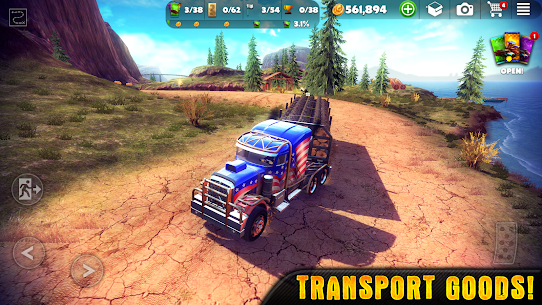
Transport missions task players with carrying specific materials to a destination. Trailers attach to trucks to haul cargo. Damage during transport can affect the load, so smooth driving is more important than fast driving. Additionally, construction site deliveries require the player to bring materials to exact map locations to trigger building sequences.
What completing a challenge earns you in coins and XP
Finishing a challenge pays out in coins and XP. Coins go directly toward buying card packs or spending in the garage. XP contributes to the player’s level rank, and each new level unlocks cool rewards — the game’s description names these rewards explicitly, though the specific items scale with level tier.
However, completion alone does not maximise the payout. Faster times and cleaner runs in speed-based events reward higher coin totals. Therefore, replaying earlier challenges with upgraded vehicles is a real strategy for building the coin reserve faster without waiting on card pack unlock timers.
Winch System and Rope Physics in OTR
The winch is one of OTR’s most distinctive mechanics. Few mobile offroad simulators simulate a physical rope with accurate tension and swing behaviour. In OTR, the cable rope behaves based on the angle of attachment, the weight of the vehicle, and the anchor point selected. This is not a simplified pull-to-location system.
Players attach the winch to terrain anchor points — trees, rocks, and fixed objects in the world. The rope extends, tightens, and pulls the vehicle forward or upward based on physics. If the angle is wrong, the vehicle swings rather than climbs. Getting the attachment point right before activating the winch is a skill that takes practice to develop.
How the winch attaches and behaves on steep terrain
On steep inclines, the winch should be anchored directly above the vehicle rather than at a side angle. A side anchor causes lateral drag, which can tip a heavy truck on loose ground. The rope physics simulate this pull direction accurately, so the angle of the cable on screen reflects the actual pull vector.
Mud terrain adds resistance. The vehicle’s tires lose grip as the chassis sinks, so combining throttle with winch tension — rather than relying on the winch alone — produces more controlled uphill movement. Players who use the winch passively without adding throttle often find progress stalls halfway up a slope.
Using the winch to drag objects and assist transport missions
Beyond climbing, the winch attaches to objects in the world. Players can drag logs, crates, and other objects toward construction sites or delivery points. This makes the winch a tool for transport missions, not just terrain traversal.
During construction challenges, dragging materials with the winch instead of loading a trailer can be faster on short-distance tasks. However, the rope physics mean objects swing when moving at speed. Slow, controlled dragging keeps objects stable and prevents them from colliding with terrain features mid-delivery.
What makes OTR’s rope physics different from other Android offroad titles
Most mobile offroad games use a static cable effect — the vehicle simply moves toward the anchor at a fixed rate. OTR simulates actual rope tension, which means the cable can go slack if the vehicle moves toward the anchor too quickly, and it snaps taut if the vehicle drops away suddenly.
This behaviour changes how players approach every winch situation. Momentum matters. A vehicle with speed moving toward the anchor needs to slow down before the rope pulls taut — otherwise the jerk motion bounces the vehicle off terrain. This level of physical accuracy is rare in the Android offroad category and is a key reason long-term players rate OTR’s traversal system above Offroad Outlaws in technical depth.
Multi-Vehicle Switching and On-Foot Exploration
OTR allows players to exit any vehicle and walk freely across the game world. This is not decoration. Walking lets players approach objects, interact with the environment, and board different vehicles positioned nearby. The freedom to leave a truck, walk to a docked boat, and sail to an island without a loading screen is central to how the open-world sandbox functions.
The vehicle roster spans five categories: land vehicles (4×4 trucks, off-road behemoths), water vehicles (boats), air vehicles (helicopters and airplanes), and trains. Each category serves a different traversal purpose. Switching between them intelligently is what separates efficient players from those who drive a 4×4 into terrain that a helicopter would cross in seconds.
Moving between cars, boats, helicopters, and on-foot mode
To board a vehicle, players walk their character to it and trigger the enter action. The transition is immediate. There is no menu — you walk to the helicopter, enter, and fly. This creates a natural, continuous session flow that other Android sandbox games rarely achieve at the same scale.
On-foot mode also reveals the world at a different scale. Collectibles placed in areas inaccessible by vehicle require walking. Some terrain zones are too narrow for any vehicle but easy to cross on foot. So the walking mechanic is both a narrative feature — the ability to hike peacefully — and a gameplay necessity for full collectible completion.
When to use each vehicle type across different terrain zones
4×4 trucks and off-road behemoths handle all land-based challenge types. Mud zones, rocky inclines, and forested terrain suit these vehicles best. Boats are the correct tool for crossing water bodies and reaching island terrain — attempting these zones with a land vehicle wastes time and risks chassis damage.
Helicopters are best used for scouting. Flying over terrain before committing a truck to a long route saves significant time in Pathfinder challenges. Airplanes cover large distances quickly but need open terrain to land safely. Trains serve fixed routes and are more useful for understanding the map layout than for active challenge completion.
How airplane and train access expands the open-world loop
Airplanes in OTR require more skill to land than helicopters — landing zones need to be relatively flat, and speed management on descent is real. However, they provide the fastest point-to-point travel in the game. Players who unlock air vehicles earlier than most find that scouting challenge locations from the air dramatically reduces the time spent searching on the ground.
Trains are the slowest but most atmospheric transport option. They run on fixed tracks within the world. Using a train shows players parts of the map they may not have reached by off-road vehicle. This makes the train a map-reading tool as much as a transport system. For players building out their spatial knowledge of the open world, a train run across the map is one of the most efficient ways to identify construction sites and cargo delivery locations.
Construction and Transport Features
The construction system in OTR is the feature most first-time players overlook entirely. Structures — including houses, bridges, and roads — can be built at designated sites throughout the open world. Building them requires transporting specific materials to each site using trucks, trailers, or the winch.
This is not a separate game mode. Construction integrates directly with transport challenges. A bridge build, for example, requires multiple cargo runs. Each successful delivery moves the build forward visibly. Completing a construction project is one of the most satisfying sequences in the game because the result changes the physical map — the bridge becomes a traversable structure that opens new routes.
How the material transport system works for building
Each construction site shows which materials are needed and how many. Players source these materials from spawn points on the map, load them using trailers, and deliver them to the build location. The material must reach the site without being lost or destroyed during transit.
Terrain between the source and the construction site matters. Sand and mud slow down loaded trucks significantly. Planning a route that uses firmer ground — or building a road to the site first — is a real strategic choice that experienced players make before starting a construction run.
What structures players can construct and why it matters
Houses, bridges, and roads are the primary buildable structures. Roads are the most strategically valuable because they reduce transit time for all future deliveries in that area. A road built early in a session makes every subsequent transport mission faster.
Bridges open map sections that are otherwise only reachable by boat or helicopter. After a bridge is complete, land vehicles can cross what was previously water. This changes the routing possibilities for future challenges in that area and is one of the best examples of how OTR’s systems interact with each other rather than operating in isolation.
Using trailers in transport challenges and construction runs
Trailers attach to the rear of compatible trucks. They increase cargo capacity significantly but reduce maneuverability. Tight terrain — particularly mountain routes — becomes much harder with a loaded trailer attached. For those areas, the winch is a better solution than a trailer.
For flat-terrain construction runs, a loaded trailer is the fastest option because multiple items move in one trip. Players who make individual trips without a trailer on flat routes are wasting coins and time. Matching the transport method to the terrain type is the skill that makes construction challenges feel rewarding rather than repetitive.
Card Packs and Vehicle Progression in OTR
The card pack system is how new vehicles enter the player’s garage. Card packs unlock over time — the unlock timer can reach up to eight hours for higher-tier packs, according to player-reported experience. This timer-based system means rushing is not an option unless players spend coins to speed up the process.
Each card pack contains vehicle cards. Collecting enough cards for a specific vehicle completes the unlock. This means progression is not purely linear — players may unlock a mid-tier truck before a basic one if the card distribution favors it. Understanding this system early prevents frustration when a desired vehicle does not appear after the first few packs.
How card packs work and how long they take to unlock
Card packs come in different tiers. Lower-tier packs open quickly and contain common vehicle cards. Higher-tier packs take longer but contain rarer vehicles including boats, helicopters, and off-road behemoths. Players accumulate packs by completing challenges and earning coins.
The most common mistake new players make is opening packs as soon as they appear without tracking which vehicles they are close to completing. Checking the card progress screen first helps prioritise which packs to open and which to save. This matters most when a transport-tier vehicle is close to unlocking — getting that vehicle sooner dramatically improves progression speed.
The XP leveling system and what each rank rewards
Each completed challenge awards XP in addition to coins. XP fills the player’s level bar. Reaching a new level unlocks rewards — the game describes these as cool rewards, though specific items scale with rank tier. Higher-level players gain access to challenge types that are locked at lower levels.
The leveling system also functions as a progression gate. Some of the most capable vehicles in the 55-car roster are linked to level milestones. Therefore, grinding XP through repeated challenge completion is not just for rewards — it directly affects which parts of the game are accessible. Players who focus only on coins and ignore XP find themselves gear-locked earlier than expected.
Weekly Ranked Race events and multiplayer progression
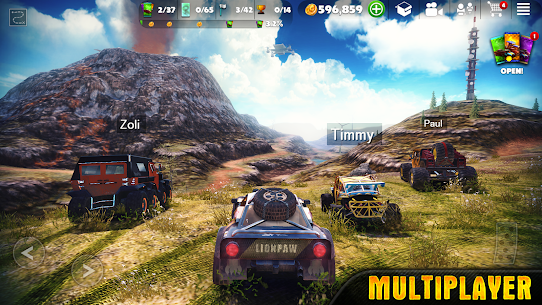
Weekly Ranked Race events are the competitive layer of OTR’s multiplayer. These events run on a set schedule against players worldwide. Performance in ranked events contributes to a leaderboard position, and the rewards for top placements are significantly better than standard challenge payouts.
Multiplayer also includes sandbox and competitive modes outside ranked events. Playing sandbox mode with others is the easiest way to understand the map quickly — experienced players often know shortcuts and construction shortcuts that newer players miss entirely. Joining a multiplayer session early in a playthrough and observing how other players navigate is one of the fastest ways to build spatial knowledge of the open world.
Advanced Terrain Tactics Most Players Miss in OTR
New players in OTR tend to treat mud, water, and elevation as obstacles to avoid. Experienced players treat them as systems to read and use. The dynamic mud deformation, buoyancy physics, and winch mechanics each contain layers that reward players who understand them.
Most competing guides in this space stop at surface-level advice — use a 4×4 for mud, use a boat for water. The tactics below go beyond that to explain what the simulation is actually doing and how to use it deliberately.
Reading mud zones and using dynamic deformation to your advantage
Mud surface deformation means tire tracks left by previous passes create ruts. Driving in your own ruts reduces resistance because the displaced mud is already moved. On deep mud zones, staying in an established rut is faster than cutting a new path, even if the rut is not a straight line to your target.
However, ruts also trap vehicles if they are too deep for the current tire width. Wide off-road tires straddle ruts more effectively than narrow tires. Checking the terrain ahead and choosing a vehicle with appropriate tire width before entering a heavy mud zone prevents the most common OTR stuck-vehicle situation — getting bogged and needing a rescue winch pull from a stationary anchor.
Water and buoyancy mechanics — when to drive in and when to switch vehicles
Driving into water cleans mud from the chassis. That is useful. However, deep water applies buoyancy force to the vehicle, which reduces tire contact with the ground. A heavy truck in shallow water still has ground contact and can drive through. That same truck in deep water loses traction and floats unsteadily.
The practical rule is this: if the water level reaches the vehicle’s door line, switch to a boat. Trying to drive a truck through chest-deep water wastes time and risks damage on submerged rocks. The buoyancy simulation is accurate enough that you can see the truck lifting slightly as depth increases — that visual cue is the signal to exit and switch vehicles.
Using the construction system to open shortcuts in the open world
Most players treat construction as a passive side activity. However, building a road between two challenge areas before starting those challenges creates a permanent speed advantage for the rest of the session. The road reduces transit time, protects vehicle integrity on rough ground, and makes trailer-based transport missions much safer.
Building a bridge on a route used frequently for cargo delivery removes the need to switch to a boat for every crossing. These structural investments pay off across many subsequent challenges. The players who see the biggest efficiency gains in OTR are those who treat the construction system as infrastructure planning rather than an optional side quest.
Best Off The Road OTR Tips and Tricks for Beginners
Prioritise winch use on mountain climbs before buying vehicle upgrades
New players often spend early coins upgrading engine power before understanding the winch. On steep terrain, a well-anchored winch cable outperforms a raw engine upgrade in every situation. The winch pulls the vehicle upward regardless of tyre grip, which is the actual limiting factor on mountain climbs.
Save coins for card packs in the early game. Use the winch aggressively on difficult terrain instead. An upgraded vehicle still needs the winch on OTR’s steepest inclines — the difference between a stock vehicle with good winch technique and an upgraded vehicle with poor winch use is not significant at early levels.
Open card packs in sequence to unlock transport-tier vehicles faster
The card pack system rewards sequential thinking. Check which vehicle is closest to unlocking before opening any pack. Then open only the packs most likely to contain that vehicle’s cards. This approach compresses the time to unlock your first boat or helicopter significantly.
Boats and helicopters are not late-game luxuries in OTR. They are core traversal tools that open large parts of the map. Getting one of these vehicles early changes the entire pacing of progression. Players who unlock a boat before completing their fourth land vehicle find that island terrain and water-based challenge types become accessible much sooner.
The most common failure point in Pathfinder challenges and how to avoid it
Pathfinder challenges are about reaching checkpoints through rough terrain without a defined path. The most common failure is choosing the wrong vehicle at the start. Heavy trucks sink into soft ground and struggle with the lateral movement these challenges require. A lighter 4×4 with good suspension handles Pathfinder routes far better.
The second failure point is ignoring the winch during the approach phase. Most Pathfinder checkpoints are positioned on elevated ground. Beginners drive straight at the slope and stall. Instead, approach at an angle, attach the winch to the highest available anchor above the checkpoint, and use combined throttle and winch tension to ascend steadily. This technique solves the majority of Pathfinder stalls.
Frequently Asked Questions About Off The Road OTR
Is Off The Road OTR free to play on Android and iOS?
Off The Road OTR is free to download on both Android and iOS. The base game includes all core features, open-world access, and challenge modes at no cost. An optional OTR VIP CLUB subscription provides additional benefits through a monthly auto-renewing plan. Players report minimal intrusive advertising within the standard version, which makes the free experience genuinely playable without spending.
Can you play Off The Road offline without an internet connection?
Off The Road OTR is fully playable offline. Single-player challenges, open-world exploration, and the construction system all function without a connection. Multiplayer modes and Weekly Ranked Race events require internet access. Players who prefer offline sandbox sessions can access nearly all content without data, making it a strong option for travel or low-connectivity situations.
How many vehicles are available in Off The Road OTR?
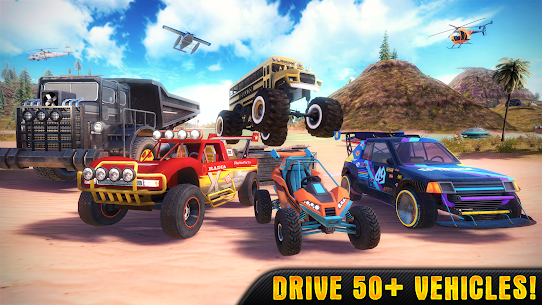
Off The Road OTR currently features 55 vehicles to unlock and drive. These span multiple categories including off-road 4×4 trucks, heavy off-road behemoths, boats, helicopters, airplanes, and a train. Players unlock vehicles through the card pack system by collecting enough cards for each specific vehicle. The roster covers all terrain types — land, water, and air — giving each vehicle category a functional role in the open world.
Final Verdict — Who Should Play Off The Road OTR
Off The Road OTR suits players who want a mobile sandbox with real mechanical depth rather than a shallow driving game dressed up with open-world visuals. The winch system, construction features, and multi-vehicle traversal loop give it a level of interacting systems that is rare in the Android category. Competitive players get Weekly Ranked Race events and global multiplayer. Exploration-focused players get a large open world with collectibles, terrain variety, and on-foot access.
Playing through the first eight hours personally, the construction system stood out as the feature that earns long-term sessions — building a bridge that opens new challenge routes changes how the map feels in a way most mobile games cannot deliver. If you enjoy open-world driving simulators and want a title with sustained mechanical rewards, Off The Road OTR earns that time.
Images
What's new
Crash fixes Added OTR2 pre-registration screen
Related apps




Developer's apps

Latest Games
Popular Games


