
Flip Master
| Developer | MotionVolt Games Ltd |
| Updated | Jun 5, 2026 |
| Size | 189 MB |
| Version | 3.7.40 |
| Requirements | 6.0 |
| Get it on |  |
Description
Flip Master is the only mobile trampoline game that gives every character its own ragdoll physics engine, so a Backflip with The Dude lands differently than the same trick with the Moon Astronaut. This post is written for beginners and returning players who want to score higher, unlock locations faster, and stop losing runs to avoidable mistakes. Below, you will find how the controls and physics work, how to use power-ups and the streak meter, which characters to train first, and the mistakes that are silently costing you coins.
What Is Flip Master and How Does It Play
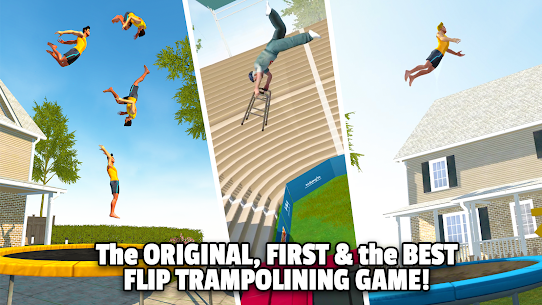
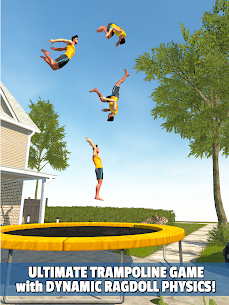
Flip Master is a mobile trampoline sports game developed and published by MotionVolt Games, available on iOS and Android. The core loop is simple: tap and hold to spin your athlete through the air, release to extend the body, and land cleanly to keep the run going. However, the ragdoll physics engine makes every jump feel different. Because the character’s limbs respond dynamically to each movement, no two falls look the same.
The game builds its replayability around score-chasing. Players earn coins mid-air, use those coins to train their athlete and spin the prize machine, and gradually unlock new tricks and trampoline locations. Additionally, the 2025 Spectators update adds a live crowd that reacts to your performance. Therefore, both the mechanical challenge and the social spectacle grow as you invest time in the game.
How the tap-and-hold ragdoll physics engine controls every flip
The ragdoll physics engine is the heart of this mobile sports game. When you tap and hold the flip button, the athlete curls tight and begins rotating. The longer you hold, the faster the spin builds. Consequently, releasing too early leaves you under-rotated and heading for a crash. Releasing too late means an over-spin that slams you flat.
Because every character has unique physics built into the engine, this timing feels subtly different across athletes. The Dude, the default character, has a forgiving arc. By contrast, a heavier character like The Football Player rotates more slowly and needs a longer hold time to complete the same Backflip. This is the most important thing to understand before spending coins.
The backyard, gym, circus, and extreme location settings
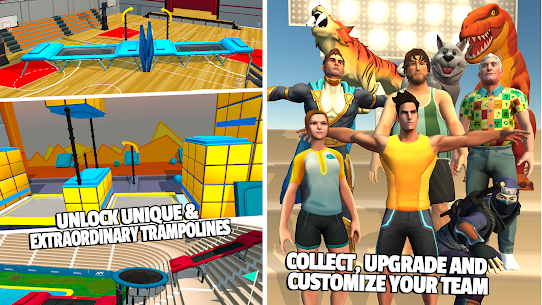
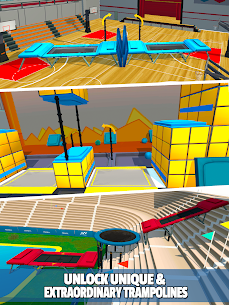
Flip Master offers more than 20 distinct locations, ranging from a simple Backyard trampoline to a Circus with multiple bouncing surfaces, a Mountaintop, a Moon location with reduced gravity, and the Castle Ruins added in the 2025 Summer update. Each setting provides a different trampoline surface and jump height ceiling. Therefore, the same trick sequence produces different scores depending on where you play.
The Moon location, for example, lets players achieve far greater air time due to reduced gravity. This makes it ideal for attempting longer trick chains. However, because landings arrive more slowly, the timing window shifts. New players who move to the Moon too early often find the slower descent confuses their release timing, which leads to more crashes than their usual locations.
How Flip Master compares to Flip Diving and Backflip Madness on Android
Flip Diving, the earlier MotionVolt game, focuses on cliff-diving into water with a single-attempt structure per jump. By contrast, Flip Master places a trampoline beneath the athlete, enabling continuous chained runs that can last minutes rather than seconds. The two games share the same ragdoll visual style, but the core challenge is completely different. Flip Diving rewards perfect single landings; this trampoline game rewards sustained streaks.
Backflip Madness by Gamesoul Studio is another Android sports title with aerial tricks, but it focuses on parkour-style launch points rather than a fixed trampoline. Flip Master’s depth comes from its per-character training system and the streak meter mechanic, neither of which Backflip Madness features. As a result, Flip Master has significantly more long-term progression for players who enjoy unlocking and upgrading.
How Flip Master Controls and Physics Actually Work
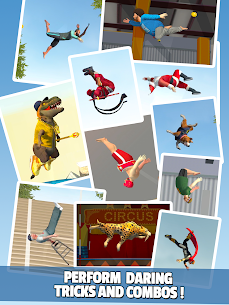
Understanding the control scheme is the fastest way to improve your score. The game uses a single tap-and-hold input system. Each trick has its own dedicated button on screen. Because the buttons map to distinct flip types, players can switch between a Frontflip, Backflip, Gainer, or Layout without lifting off the trampoline between jumps. This is what makes long trick chains possible.
The physics engine responds to how long you press each button and how well you have trained your athlete’s relevant skill. A character with high rotation training spins faster and more consistently. Therefore, spending coins on training before attempting harder tricks produces better results than jumping straight into 13-trick combos on a fresh character. The game rewards investment.
Tapping and holding to curl, spin, and time your rotation
When you press any trick button, the ragdoll curls into a tight tuck position and begins rotating. The rotation speed depends on two factors: the Superspin power-up (if active) and the character’s Rotation training level. Each additional training level in the Rotation category adds measurable speed to the spin. So a fully trained character completes full rotations noticeably faster than an unupgraded one.
The key skill new players need to build is feel for the rotation. Watch the athlete’s body as it spins. The goal is to release the button when the athlete is roughly parallel to the trampoline surface — feet slightly ahead of center. This position gives the ragdoll physics the best chance to absorb the landing correctly. It takes around 20 to 30 practice jumps per trick to build that feel reliably.
The release timing window that decides every landing
Releasing too early is the most common beginner mistake. When the body is still angled backward on release, the feet hit the trampoline at the wrong angle. The ragdoll then crumples, and the run ends. Releasing too late causes an over-rotation, where the athlete lands face-down or on their head, which is also a run-ender.
The sweet spot is a narrow window just before the feet are fully below the body. However, this window gets more forgiving as you train the Balance skill category. Balance directly affects how much error the physics engine allows on each landing. Therefore, training Balance early — even before unlocking new tricks — extends your runs significantly and makes the controls feel much more predictable.
What happens when you stick a landing versus crash out
A clean landing rebounds the athlete directly upward, maintains the current height, and keeps the streak meter running. Additionally, a perfect landing into the next jump rewards bonus height, which means more air time for the following trick. This height compounding is the mechanic that lets high-level players reach impressive altitudes without power-ups.
A crash landing stops the run entirely. However, the game does allow limited recovery from near-bad landings. If the athlete lands slightly off-balance but not fully wrecked, players can choose to take one or two half-spins or minor bounces to stabilise, sacrificing streak progress temporarily. This recovery window is one of the most underused mechanics in Flip Master and is covered in detail in the tips section below.
What Are All the Flip Master Locations
Locations in Flip Master are more than visual backdrops. Each trampoline surface has different physical properties, affecting maximum jump height, surface springiness, and the available scoring ceiling. Unlocking new locations happens through the prize machine, which players spin using coins earned during runs. The prize machine cost increases slightly with each spin, so efficient coin earning is important.
Standard locations include the Backyard, the Gym, the Competitive Trampoline, the Circus, and the Trampoline Park. These form the core rotation for most players. Beyond these, MotionVolt has added extreme and themed locations in regular updates, expanding the game substantially since its 2017 launch. Moreover, each location tracks its own high score, which gives players long-term goals across the full roster.
Standard locations from the Backyard to the Trampoline Park
The Backyard is where every player starts. It has a small trampoline with moderate springiness, making it a reliable learning environment for timing. The Gym trampoline is larger and bouncier, which helps players reach greater heights and attempt more rotations per jump. Therefore, most players notice an improvement in their scores when they first unlock the Gym.
The Trampoline Park stands out because it features multiple trampolines side by side. Players can jump between surfaces, which creates longer sustained runs. The Circus location also has this multi-surface layout. These multi-trampoline environments reward players who have already practised their directional control, so they work best once the athlete’s Balance and Jump Height training levels are at least partially upgraded.
Extreme and seasonal locations including the Moon and Castle Ruins
The Moon location, added in a past update, changes the physics dramatically. Reduced gravity means the athlete floats higher and longer between each bounce. This creates opportunities for more trick rotations per jump, which raises the scoring ceiling considerably. However, it also means the descent takes longer, so the release timing window shifts later in the arc compared to Earth-based locations.
The Castle Ruins and forest river locations, introduced in the 2025 Summer update, are environmental locations with unique visual challenges. Seasonal and update-based locations tend to include interactive elements — the Castle Ruins has a bell players can strike during a run. These interaction points do not affect core physics but do add bonus scoring opportunities. Additionally, they give long-term players new reasons to return to the game.
How each location type affects jump height and trick scoring
Scoring in Flip Master rewards height and trick variety in combination. A higher jump gives more air time, which gives more opportunity to complete full rotations and chain longer trick combos. As a result, springier trampolines tend to produce higher scores for skilled players. The Gym and Trampoline Park consistently generate higher raw scores than the Backyard for this reason.
However, scoring also scales with streak maintenance. A location that is easy to land on consistently — like the Gym — can produce better overall scores than a higher-ceiling location where the player crashes frequently. So the best location for scoring is not always the most extreme one. It is the one where the player can maintain the longest unbroken streak with their current training level.
What Are the Flip Master Power-Ups and How to Use Them
Power-ups in Flip Master are temporary boosts that players activate before or during a run. They do not replace skill — they amplify what the player can already do. Therefore, using a Superjump on an untrained character with poor landing timing usually results in a spectacular crash rather than a high score. Power-ups pay off most when the athlete’s core training is solid.
The game offers several power-ups across two broad categories: movement boosters and protection tools. Movement boosters increase jump height, spin speed, or push force. Protection tools, such as the Safety Net, prevent run-ending falls. Coin-generating power-ups like Coin Rain occupy a third utility category. Each category serves a different goal, and combining them wisely multiplies their effect.
Core power-ups — Superjump, Superspin, and Superpush explained
Superjump increases the athlete’s maximum bounce height by 50 percent for the duration of the run. This is the most universally useful power-up for score-focused sessions because greater height directly means more air time per jump. Players who already have solid landing timing benefit most from Superjump because they can fully use the extra rotations it enables.
Superspin doubles the athlete’s rotation speed for 90 seconds. It is most useful for players attempting tricks that require many full rotations, such as stacked Gainers or Layout combos. However, Superspin can actually hurt beginners because the faster rotation compresses the release window. Consequently, players who have not yet built reliable feel for their timing may crash more with Superspin active than without it.
Superpush increases lateral push speed by 100 percent. It is most valuable in multi-trampoline locations like the Trampoline Park, where horizontal control between surfaces matters. In single-trampoline locations, Superpush has limited value. So save it specifically for the Circus or Trampoline Park runs where directional speed has a direct impact on how long you can sustain the run.
Coin Rain, Safety Net, Medicine Ball, and Foam Cube uses
Coin Rain is a coin-farming power-up rather than a performance booster. It spawns additional coins in the air during the run. Because the game’s progression depends on coin income — for training, location unlocks, and prize machine spins — Coin Rain is consistently one of the highest-value power-ups for players in the mid-progression stage. Use it on locations where you can already land reliably and sustain long streaks.
The Safety Net prevents the athlete from falling off the trampoline edges for the duration of its effect. It is especially useful in multi-trampoline locations or when attempting high-altitude trick chains. However, it does not prevent a crash from poor landing rotation — it only saves you from edge falls. The Medicine Ball and Foam Cube are prop-based power-ups that change the physical object the athlete interacts with mid-jump, adding chaos and visual flair without directly boosting scoring.
Best power-up combinations for scoring runs versus coin farming
For maximum score on a single run, combine Superjump with Superspin only once your Balance and Rotation training are both at least three levels in. This combination gives you the height and spin speed to chain multiple full-rotation tricks per jump. Additionally, activating them on a high-ceiling location like the Gym or Trampoline Park amplifies the effect further.
For coin farming, pair Coin Rain with a location you know well and can survive without crashing. The goal in a farming run is duration, not peak height. Therefore, choose a medium-difficulty location where you can sustain a streak comfortably, not the hardest location available. A 10-minute stable Backyard run with Coin Rain active earns far more coins than a 30-second Moon run that ends in a crash.
How Flip Master Characters and Training Work
Each character in Flip Master is not simply a cosmetic choice. Because every athlete uses a different physics profile, switching characters fundamentally changes how each trick feels and how landing timing works. New players who assume all characters handle identically often feel confused when they try a different athlete and suddenly crash far more than usual.
The training system gives players five skill categories to invest in per character. Each category improves a specific physical quality. Coins are the currency for training, and each upgrade level increases in cost. However, training even one level in the right category at the start of the game produces a noticeable improvement in how a run feels. This is one of the most important early decisions a new player makes.
How per-character physics change your trick timing
The Dude, the default character, has a balanced physics profile. His rotations are moderate speed, and his landings are reasonably forgiving. As a result, he is the best character for learning the game. The Moon Astronaut, by contrast, has a lighter frame and spins more quickly in the air. This makes the release window shorter and harder to time.
Heavier characters like The Football Player rotate more slowly, which benefits players who find the standard timing too fast. Importantly, this means the same Backflip that requires a one-second hold on The Dude may require a 1.5-second hold on The Football Player to complete the same rotation. So when you switch characters, expect to spend at least 10 to 15 practice jumps recalibrating your muscle memory for the new physics profile.
The five training skill categories and what each one improves
The five training skill categories are Jump Height, Rotation, Balance, Trick Count, and Readiness. Jump Height increases the maximum altitude the athlete reaches from each bounce. Rotation improves spin speed and consistency. Balance directly expands the landing tolerance window, making it more forgiving when release timing is slightly off.
Trick Count determines how many different tricks are available to perform in a single run. Readiness affects how quickly the athlete responds to input after a landing. For beginners, the most impactful early investments are Balance first and Jump Height second. These two categories make the game feel noticeably more controllable before you touch any of the others.
Which characters to unlock and train first for better scores
The Dude is the right character to train first. Because he has the most forgiving physics profile, fully training him teaches you the core game mechanics without the additional complexity of a specialist character’s quirks. Spend the first 500 to 800 coins on his Balance and Jump Height categories before anything else.
After The Dude reaches a solid training level, Agent X1 is a strong second character to invest in. Agent X1 has above-average Rotation speed in his physics profile, which makes Gainer combos and multi-rotation tricks more accessible. However, his Balance window is tighter than The Dude’s. Therefore, only move to Agent X1 once you are consistently landing clean in your regular Dude runs.
What Mistakes Cost Most Flip Master Players Their Run
Most new players lose their runs to the same three mistakes. These errors are not about the physics being unfair — they are about misunderstanding how the streak meter, the recovery system, and the training economy actually work. Fixing these three habits alone will more than double a beginner’s average run length within the first few sessions.
The mistakes are: repeating the same trick until the streak breaks, attempting to perform complex tricks immediately after a bad landing instead of stabilising first, and spending coins on new locations before sufficiently training the current character. Each of these costs players coins, run length, and progression time. However, they are all fixable once the underlying mechanic is understood.
Why the streak meter breaks when you repeat the same trick
The streak meter tracks whether the player is consistently varying their tricks. Performing the same trick ten times in a row does not maintain the streak — it breaks it after a short repeat. The game’s streak system specifically requires trick rotation. Therefore, the player must cycle through at least two or three different tricks to keep the multiplier running.
This is the single most misunderstood mechanic in Flip Master. Many players assume the streak is maintained by landing cleanly, but clean landings only prevent a crash — they do not automatically sustain the streak if the same trick repeats. A practical approach is to assign two or three favourite tricks and cycle through them deliberately on each jump. Alternating Backflip, Gainer, Backflip is enough to maintain a full streak continuously.
How to recover from a bad landing instead of forcing tricks
When a landing goes slightly wrong, the natural instinct is to start spinning immediately into the next big trick to make up for the lost momentum. This is a mistake. A shaky landing means the athlete’s ragdoll is not properly centred for the next jump. Forcing a full rotation trick from this position almost always results in a crash.
Instead, take one or two very simple half-spins or minor bounces after any bad landing. This resets the athlete’s position on the trampoline surface. Even though the streak meter pauses during these recovery bounces, the run continues. A continued but lower-score run always beats a crashed run that ends completely. Recovery is a skill, and practising it deliberately during low-pressure runs builds the instinct for higher-pressure sessions.
Why skipping character training early destroys your scoring potential
New players often spend their first few hundred coins on the prize machine to unlock new locations instead of training their character. This feels rewarding in the short term because new locations are exciting. However, without trained Balance and Jump Height, the player crashes just as often in the new location as in the old one — and earns fewer coins per run as a result.
Training first creates a compounding benefit. Better Balance means longer runs. Longer runs earn more coins per session. More coins per session means faster access to both the prize machine and further training levels. So investing in training before location unlocks is not just a stylistic choice — it is the faster path to unlocking everything the game offers.
Best Flip Master Tips and Tricks for Beginners
These three tips are specific to how Flip Master’s mechanics actually work. They are not general mobile game advice — each one addresses a system unique to this game that directly determines whether your runs end at 30 seconds or last for several minutes.
Applying all three together creates a compounding effect. Better trick rotation sustains the streak. Better coin investment from training extends every run. And better landing reads from understanding the ragdoll physics stop the crashes that were ending your runs prematurely.
How to use the streak meter’s trick rotation requirement to chain longer runs
Build a personal rotation of exactly three tricks and cycle through them in the same order on every jump. Backflip into Gainer into Frontflip is a reliable starting sequence because all three involve different directional rotations. This makes it easy to remember the cycle mid-run without thinking. Because the streak meter requires variety, a three-trick cycle satisfies the requirement consistently while keeping the cognitive load low.
Additionally, do not chase new tricks too early. Unlocking a new trick through training does not immediately mean it belongs in your streak cycle. First, spend 10 to 15 practice jumps on the new trick in isolation to understand its timing. Then, introduce it into your rotation cycle only once you can land it reliably from your current height. Rushing a new trick into a live run before learning its timing is the most common way experienced players end their best runs.
How to spend coins on training before unlocking new locations
Allocate the first 600 to 800 coins you earn entirely to your starting character’s Balance and Jump Height categories. Do not spin the prize machine until both of those training categories are at level three or higher. This threshold is meaningful because level three Balance noticeably widens the landing tolerance, and level three Jump Height gives enough altitude to comfortably fit multiple trick rotations into each jump.
After reaching that training baseline, spend the next block of coins on the prize machine to unlock one or two new locations. Then return to training — specifically Rotation and Readiness — before unlocking further locations. This alternating spend pattern keeps the gameplay feeling fresh while ensuring the character’s physics are always strong enough to actually use what the new locations offer.
How to read landing timing in the ragdoll physics engine to stop crashing out
The most reliable visual cue for release timing is the position of the athlete’s feet relative to the trampoline surface. When the feet are directly below the hips and pointing toward the trampoline, the body is in the correct position to absorb the landing. Release the trick button at that exact moment. Because the ragdoll physics engine renders this position clearly, it is visible even at high rotation speeds.
At faster spin speeds — particularly with Superspin active — this window becomes shorter. So slow the playback of any recorded replay to study exactly where your timing succeeds versus where it fails. Flip Master’s replay feature is not just for sharing funny crashes. It is a direct training tool. Players who review one or two replays after a session improve their landing consistency faster than those who simply repeat runs without feedback.
Frequently Asked Questions About Flip Master
Is Flip Master free to play on Android and iOS?
Flip Master is free to download on both Google Play and the Apple App Store. The game contains in-app purchases for cosmetic items and optional ad removal tied to specific purchases. However, all core gameplay, tricks, locations, and characters are accessible without spending real money. Players can earn everything using coins collected during normal runs.
How hard is Flip Master and does it get more difficult over time?
Flip Master starts accessible for new players and becomes progressively more challenging as locations unlock. The Backyard and Gym trampolines are forgiving and well-suited to beginners. Extreme locations like the Moon and multi-trampoline environments introduce significantly harder landing timing. Additionally, the Minigame modes — Wind Tunnel, Human Fortuna, and Cannon Shoot — offer distinct challenge types beyond the standard trampoline format.
Does Flip Master get new updates and locations regularly?
Flip Master receives regular major updates. The 2024 Summer update added three Minigame modes, and the 2025 Summer update introduced Spectators, new forest river locations, and the Castle Ruins stage. MotionVolt Games also adds new playable characters and bug fixes with each update cycle. The game is actively maintained and has grown considerably beyond its original 2017 location roster.
Why Flip Master Is One of the Best Mobile Sports Games Right Now
Flip Master earns its place among the best mobile sports games through the depth of its ragdoll physics engine and the genuine progression loop built around character training. The game is easy to pick up in a 30-second session but hard to put down once you start chasing streak records and grinding coin upgrades. After spending real time with the game, the moment a fully trained character lands a perfect four-rotation Gainer into a Backflip into a clean Gainer combo on the Gym trampoline is genuinely satisfying — not just visually, but mechanically.
The game suits players who enjoy score-attack mobile games with skill-based progression. Casual players get immediate fun from the ragdoll crash comedy alone. However, players who invest in the training system discover a game with far more depth than it first appears to have. The Minigame modes added in 2024 and the Spectators update in 2025 show that MotionVolt is committed to keeping the experience fresh.
Flip Master is one of the few free mobile sports games where the skill ceiling is high enough to keep long-term players engaged. It rewards practice, punishes impatience, and makes every clean streak feel earned.
Images
What's new
Underwater & Streamer update is here!
Bounce on trampolines under the sea!
New Characters:
- The Classic Diver, vintage deep-sea suit!
- Two new Streamer characters, ready to go live!
Plus bug fixes & SDK upgrades.
Jump in now!
Related apps


Latest Games
Popular Games


